Google Demonstrates Quantum Contextuality on Processors With Up to 105 Qubits
November 19, 2026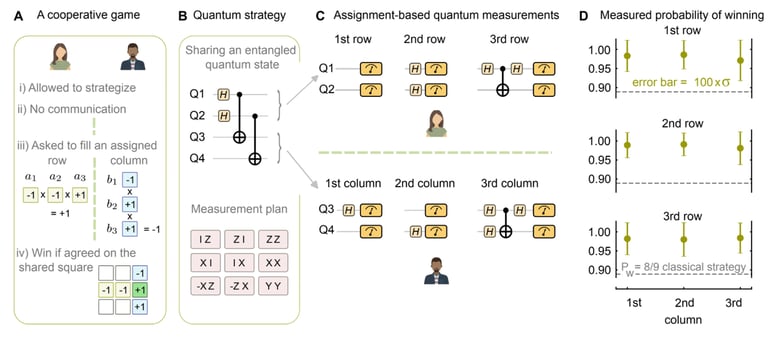


Google Quantum AI and collaborators report in a study published in Science that they demonstrated quantum contextuality on superconducting processors, extending tests to tasks involving as many as 105 qubits.
Contextuality describes how quantum measurement outcomes depend on which other compatible measurements are made, rather than revealing properties fixed in advance.
To test it, the researchers used cooperative games whose rules can be impossible to satisfy with fixed, preassigned answers; quantum measurements let players’ responses depend on the measurements performed.
In the four-qubit Mermin–Peres Magic Square game, the processors won 98.3% of 900,000 trials, above the 88.89% classical limit.
In a separate GHZ parity game, quantum strategies outperformed classical ones at every tested size up to 71 qubits, though the advantage narrowed as the number of players increased.
The team also used four-layer controlled-Z circuits to solve two-dimensional hidden-linear-function problems on grids of up to 105 qubits, with success probabilities above 0.5 and effective depths of roughly four to six layers.
The researchers say these structured tests can expose subtle coherent control errors, including over-rotations that random-circuit tests may average out; noise caused about one loss in every 60 game rounds.
In a separate Kochen–Specker–Bell test, the measured value was 5.618 ± 0.005, above the classical bound of 4 and near the quantum limit of 6, with experimental errors accounting for the remaining gap.
The experiments also examine contextuality’s connection to non-Clifford magic states, a resource relevant to fault-tolerant quantum computing; the Clifford-based test circuits themselves remain efficiently simulable classically.
The results do not establish an unconditional quantum advantage for general computation: they address specific bounded-resource tasks, and the paper’s comparison with near-term classical computational depth is conjectural.
The authors present contextuality tests as potential hardware benchmarks and suggest that improved error detection and reliable scaling could eventually support applications such as chemistry and materials science, which these experiments did not demonstrate.
Summary based on 7 sources
Get a daily email with more Tech stories
Sources

TNW | Google • Nov 19, 2026
Google Quantum AI tests quantum contextuality on up to 105 qubits
Unite.AI • Nov 19, 2026
Google Quantum AI Demonstrates Contextuality Across 105 Qubits
Quantum Computing Report • Nov 20, 2026
Google Quantum AI Demonstrates Measurement Contextuality Across 105 Qubits on Willow Processors
Google • Nov 19, 2026
How we’re putting one of quantum mechanics’ deepest features to the test at scale.