Scientists Discover 5-Million-Year-Old Coral Atoll Deep Beneath the Atlantic
November 23, 2026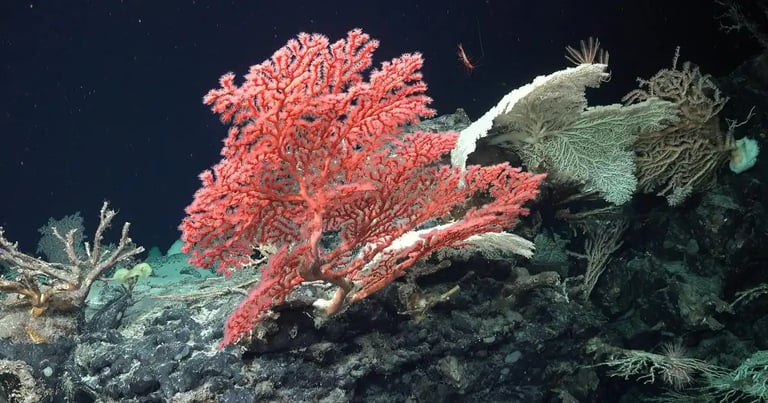

A Brazilian-led international team documented a submerged coral atoll estimated to be 5 million years old in the Romanche Fracture Zone, confirming the hypothesis that coral atolls once existed in this part of the equatorial Atlantic.
The atoll is about 300 meters tall, with its peak 900 meters below the surface, and now supports a thriving coral garden; its discovery confirms a decades-old hypothesis that atolls once existed in the mid-Atlantic, where none are found today.
During a 35-day expedition aboard Schmidt Ocean Institute’s research vessel Falkor (too), scientists used ship-based and autonomous mapping, then the remotely operated vehicle SuBastian, to locate and investigate the seafloor.
The team surveyed four areas of the 950-kilometer fracture zone, exploring depths from 600 to 4,000 meters.
The expedition captured the first visual evidence of diverse, vulnerable ecosystems in the region, including ancient sponge gardens, cold-water corals estimated to be up to 1,000 years old, zoanthid meadows, squids and octopuses.
Among the unexpected findings were a sponge and coral garden at 4,300 meters and a field-sized carpet of tiny pink zoanthids at 1,200 meters.
The Romanche Fracture Zone is the Atlantic’s longest geological fault, where deep valleys and steep slopes meet currents that mix North Atlantic Deep Water with Antarctic Bottom Water; sinking material from surface phytoplankton blooms may help feed ecosystems on the seafloor.
Researchers suspect some collected samples may represent new species, and the expedition’s extensive data could support decades of research.
Chief Scientist Dr. Jose Angel Perez said the findings establish the region’s ecological and biological uniqueness and strengthen the case for considering it for protection under the High Seas Treaty.
Summary based on 2 sources
Get a daily email with more Science stories
Sources

MarineLink • Nov 23, 2026
Scientists Discover Sunken Prehistoric Coral Atoll on Mid-Atlantic Ridge
Ocean News & Technology • Nov 23, 2026
Falkor (too) Expedition Uncovers 5-Million-Year-Old Atoll In Romanche Fracture Zone