Volcanic Eruptions Found Near Challenger Deep, Raising Mysteries About Earth’s Deepest Waters
November 23, 2026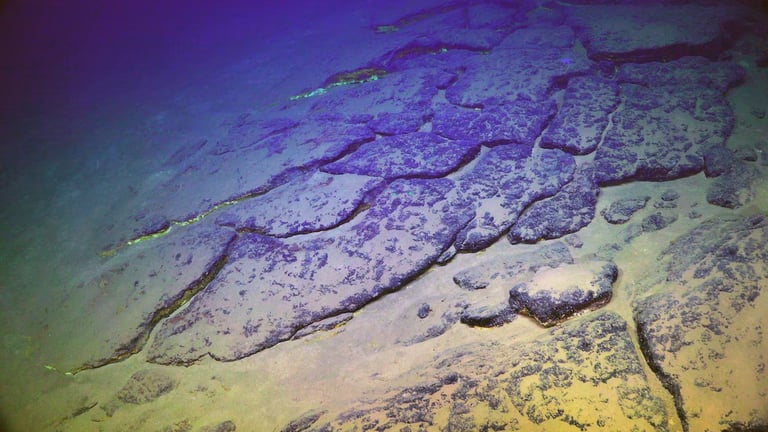

Researchers hope to return to identify the eruption sites and investigate depths beyond Jason/Medea’s reach, as the discoveries raise broader questions about submarine volcanism and plate motion in the western Pacific.
A research team using the remotely operated vehicle Jason/Medea found evidence of volcanic eruptions near Challenger Deep, the deepest known point of the seabed—an unexpected discovery in a region where the mantle is generally considered too cool to melt.
The deposits are the deepest pyroclastic deposits reported on Earth, and the findings were published November 23 in Frontiers in Earth Science.
Cameras recorded pancake-like formations at three sites across a 60-mile stretch, and recovered rocks contained volcanic glass and textures associated with pyroclastic flows—fast-moving mixtures of hot rock, ash and gas.
The team found the deposits during a late-2024 expedition, but Jason/Medea can descend only about 6.5 kilometers, so researchers sampled the trench wall rather than reaching Challenger Deep itself; they have not located the eruption site.
At the deposits’ depth, water pressure is about 592 times atmospheric pressure at Earth’s surface, leaving researchers unsure how magma and gases behave under such conditions.
One possibility is that water released from the magma formed a supercritical fluid, a state between gas and liquid, which may have limited explosive expansion while helping produce the dense, fragmented deposits.
Researchers cannot yet say whether the eruptions were explosive in the way they would be on land; under immense pressure, gases may have stayed dissolved while magma fragmented as it escaped the seafloor.
The rocks’ source remains unknown, though researchers think hot pyroclastic flows traveled only a limited distance before cooling and welding their fragments into hard rock.
The forearc ridge also shows a striking east-west contrast: the eastern section exposes mantle rocks and traces of crust about 50 million years old, while the western section is dominated by young volcanic rocks.
Researchers suggest the east may be stretching through mechanical pulling while magma is adding material in the west, but further sampling and dating are needed to test the idea.
The findings may also help explain Challenger Deep’s exceptional depth: the subducting plate’s narrow, short shape and relatively free movement could let it bend sharply as it sinks, bringing volcanic activity unusually close to the trench.
Summary based on 8 sources
Get a daily email with more Science stories
Sources

Science • Nov 23, 2026
World's Deepest Explosive Volcanic Eruption Just Discovered in an Oceanic Trench
Phys.org • Nov 23, 2026
Robot submarine exploring world's deepest ocean trench finds unprecedented volcanic activity
Popular Science • Nov 23, 2026
Mysterious volcanic rock discovered in the Mariana Trench