ESA's JUICE to Unveil Secrets of Interstellar Comet 3I/ATLAS After Solar Encounter
October 12, 2025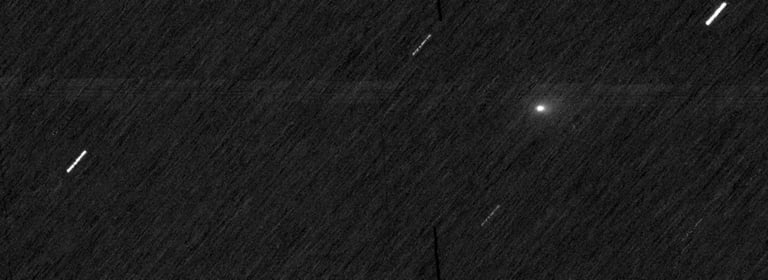

3I/ATLAS, believed to be a comet ejected from another star system, has been actively releasing water vapor as it nears the Sun, displaying typical cometary features like a coma and tail, though its behavior also raises questions about its true nature.
ESA's JUpiter Icy Moons Explorer (JUICE) is set to observe the interstellar object 3I/ATLAS after its closest approach to the Sun in November, with data expected by February that could shed light on its composition and origin.
The visible coma of 3I/ATLAS was captured by the CaSSIS camera on ExoMars and the HRSC on Mars Express, revealing a coma extending roughly 56,000 km behind the object, but the tail remained too faint to be observed in the images.
Both ESA's Mars Express and ExoMars TGO, when the object was within 30 million km, used their specialized cameras to image 3I/ATLAS, although its faintness made detailed observation challenging.
Studying interstellar objects like 3I/ATLAS provides valuable insights into materials from other planetary systems, offering a cost-effective and timely alternative to interstellar missions and helping to understand galaxy formation.
Spectral data collected by Mars orbiters may help determine 3I/ATLAS's composition, though further analysis is needed as the object becomes more active near the Sun.
The ESA's upcoming Comet Interceptor mission, planned for launch in 2029, aims to study comets and interstellar objects in high resolution, waiting in orbit for future ISO detections to deepen our understanding of their diversity.
Summary based on 1 source