AI-Driven Astrobee Revolutionizes ISS Robotics with Autonomous Navigation Breakthrough
December 6, 2025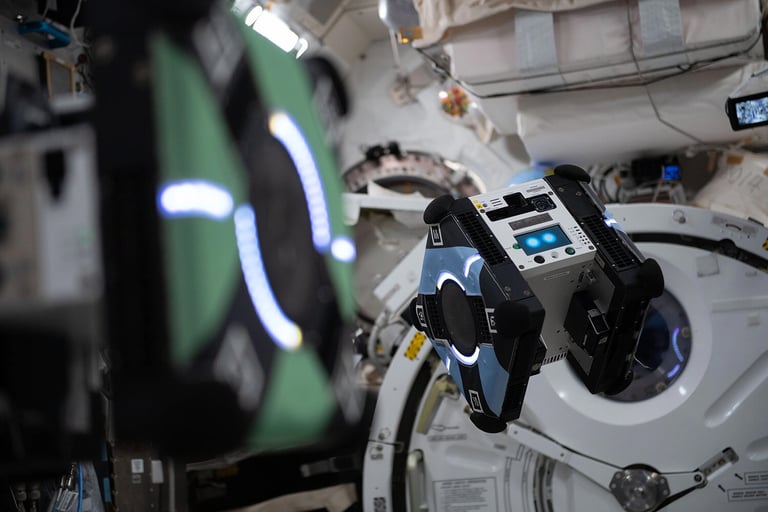


The article highlights AI’s role in transforming robotic autonomy aboard the ISS, with faster, safer navigation and less need for direct astronaut guidance, as shown by the arXiv study.
The approach builds on sequential convex programming and is trained on thousands of past paths to recognize typical corridors and obstacles, boosting planning speed by roughly half to sixty percent in tests.
A warm-start concept leverages prior knowledge to initialize planning, reducing computation time while preserving safety.
A Stanford-led study demonstrates that machine-learning–based control can safely guide Astrobee, the cube-shaped robot on the ISS, marking the first AI-assisted control on the station.
The breakthrough enables autonomous path planning and dynamic adaptation to the station’s environment, delivering significant speed gains in navigation.
NASA Technology Readiness Level 5 was reached after ISS testing, indicating real-environment validation and low risk for future missions.
In ISS trials, 18 trajectories were tested, each over a minute; warm-start AI planning outperformed cold-start methods in cluttered, tight, and rotating maneuvers.
The system uses a warm-started ML model to accelerate trajectory optimization while enforcing strict safety constraints for the ISS’s confined space.
Validation began at NASA Ames with a granite-table testbed, followed by ISS demonstrations where astronauts had minimal involvement, safeguarded by virtual obstacles, a backup robot, and abort options.
The space environment’s higher uncertainty and disturbances demand resource-constrained AI, underscoring the need for safe autonomous operation.
The project’s emotional and inspirational impact is underscored by observers, including Sunita Williams, sharing the moment of Astrobee in action with the research team founder Banerjee.
Looking ahead, autonomous space robotics with built-in safety will be essential for distant, frequent missions to the Moon and Mars, reducing reliance on ground control and enabling complex autonomous tasks.
Summary based on 2 sources
Get a daily email with more AI stories
Sources

The Daily Galaxy - Great Discoveries Channel • Dec 6, 2025
These AI-Powered Robots Are Shattering Boundaries in Space – Ushering in a New Era of Exploration!