LUX-ZEPLIN Sets New WIMP Limits, Detects Solar Neutrinos with Unmatched Sensitivity
December 8, 2025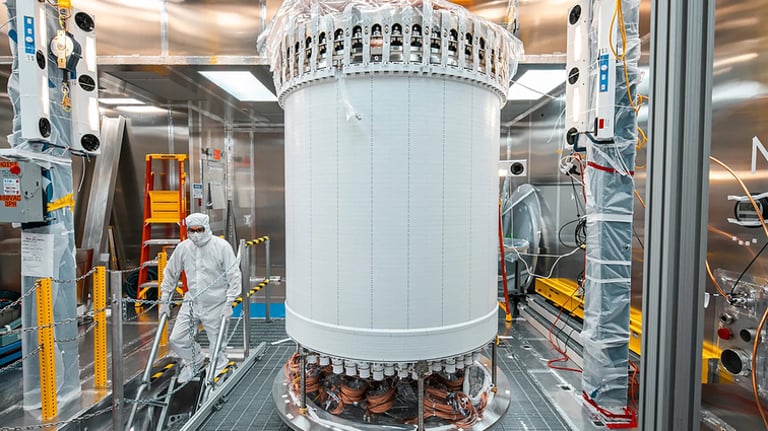

Solar neutrino signals are detected, contributing to the broader neutrino physics program.
The latest analysis of the largest dark-matter dataset finds no evidence for WIMPs in the 3–9 GeV/c2 range, while extending sensitivity for higher masses and tightening theoretical scenarios.
Specifically, the study sets the strongest constraints to date on low-mass WIMPs within the 3–9 GeV/c2 window.
Results were presented at SURF and prepared for arXiv and Physical Review Letters, refining the understanding of dark-matter properties and interactions.
LZ has set world-leading WIMP limits and achieved the first solar-neutrino detection with the experiment, marking a milestone in sensitivity.
Solar boron-8 neutrinos are detected via coherent elastic neutrino-nucleus scattering in xenon, offering a new avenue to study solar neutrinos.
The study probes low-mass WIMPs as dark-matter candidates while confirming boron-8 solar neutrino interactions with xenon, aiming to sharpen the ability to distinguish potential dark-matter signals from neutrino events.
LLNL researchers, including Rachel Mannino, lead data acquisition, calibration, and background mitigation, shaping the experiment's calibration and analysis strategy.
LZ remains the most sensitive direct-detection dark matter experiment and is poised for potential discovery, with results validating its enhanced performance and expanded reach into new dark matter models.
A longer second run is planned to begin in 2028, expected to last about 1,000 days, to boost chances of detecting rare events and to explore physics beyond the Standard Model.
LUX-ZEPLIN conducted a 417-day run from spring 2023 to spring 2025 using a liquid xenon chamber to search for dark matter and observe solar neutrinos.
The team emphasizes the value of negative results, which refine models and guide future experiments rather than indicating failure.
The neutrino observations reached 4.5 sigma confidence, improving on prior sub-3-sigma results and helping reduce false positives in future dark-matter searches.
Neutrino observations create a background—referred to as a neutrino fog—for low-mass dark matter searches, while also enriching neutrino physics and solar fusion studies.
The experiment detects solar boron-8 neutrinos with unprecedented sensitivity, underscoring the neutrino fog concept in low-mass dark-matter searches.
LZ’s ongoing program aims to reach over 1,000 live days by 2028, broaden sensitivity to higher mass ranges (100 GeV/c2 to 100 TeV/c2), and lower energy thresholds to probe lighter dark matter, while reducing backgrounds.
Future plans include collecting more than 1,000 additional days by 2028 to enhance sensitivity across a broad mass range and pursue exotic dark-matter interactions and next-generation detectors studying neutrinos.
The detector uses 10 tons of ultrapure liquid xenon to capture nuclear recoils from potential WIMPs and signals from solar neutrinos, with energy deposition measured via light and ionization.
The 10-ton xenon detector sits deep underground, shielded to minimize background, recording both dark-matter interactions and boron-8 solar-neutrino signals.
Brown University researchers contributed by leading neutron calibration, developing detector hardware (PMT arrays), and building machine-learning tools to separate signals from background.
The analysis used data from March 2023 to April 2025, totaling 417 live days, focusing on probing WIMPs below 9 GeV/c2 for the first time in LZ.
No definitive evidence for low-mass WIMPs was found, despite enhanced sensitivity and detector improvements.
Summary based on 3 sources
Get a daily email with more Science stories
Sources
Live Science • Dec 8, 2025
Historic search for 'huge missing piece' of the universe turns up negative — but reveals new secrets of…
Brown University • Dec 8, 2025
LZ experiment sets new record in the hunt for dark matter, glimpses neutrinos from the sun’s core
Mirage News • Dec 8, 2025
LZ Experiment Leads, Detects Solar Core Neutrinos