Monster Stars: James Webb Telescope Uncovers Ultra-Massive Stars Shaping Early Universe
December 9, 2025

Astronomers using NASA’s James Webb Space Telescope report the first compelling evidence for ultra-massive “monster stars” in the early universe, with masses ranging from 1,000 to 10,000 solar masses, identified by distinctive chemical signatures in galaxy GS 3073.
Modeling of 1,000–10,000 solar-mass stars shows a helium-burning pathway that produces carbon, enables a CNO cycle to generate nitrogen, and ejects nitrogen-rich material into the surrounding gas.
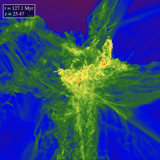
The work, led by the CfA and the University of Portsmouth, is published in Astrophysical Journal Letters and builds on 2022 Nature predictions of massive primordial stars forming from turbulent cold-gas streams.
Findings point to a narrow mass window—1,000 to 10,000 solar masses—required to produce the observed nitrogen signature, suggesting a specific era and conditions for ultra-massive first stars during the cosmic Dark Ages.
The study anticipates future JWST observations will uncover additional galaxies with similar nitrogen excesses, strengthening the case for ultra-massive first stars and their role in seeding early black holes.
The study concludes these monster stars likely collapse directly into massive black holes rather than exploding, potentially explaining the actively accreting black hole observed in GS 3073 and linking to early black-hole formation.
GS 3073 exhibits a nitrogen-to-oxygen ratio of 0.46, an extreme abundance that cannot be explained by known stars or stellar explosions, indicating the influence of primordial, ultra-massive stars.
Summary based on 1 source