NASA's ESCAPADE Mission: A Bold Step in Low-Cost, High-Risk Mars Exploration
December 9, 2025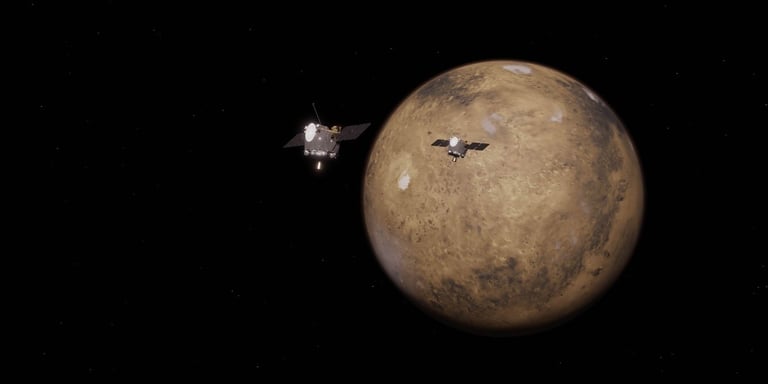

The program accepts higher risk and narrower scientific scope compared with flagship missions, aiming for valuable but more modest science while expanding the mission count under budget constraints.
This shift is enabled by cheaper launches and off-the-shelf hardware, with tighter cost controls shaping mission design across the industry.
ESCAPADE’s development endured near-cancellations, delays, weather and ground-utility issues, a solar storm around launch, and a government-shutdown-related restriction, culminating in a successful November 2025 lift-off.
Launch challenges included weather delays, a solar storm, and shutdown-era restrictions, all resolved in time for contact with the spacecraft after liftoff.
As a SIMPLEx mission, ESCAPADE emphasizes small payloads and aggressive cost targets while pursuing meaningful insights into Mars’ space environment.
Historical SIMPLEx missions have faced failures or cancellations, illustrating the trade-offs between cost reduction and mission resilience.
NASA faces budget pressures and a surge in commercial space, driving a shift toward faster, cheaper, smaller missions that can boost science return if enough missions succeed, though they offer less transformative science than flagship missions.
ESCAPADE faced last-minute hurdles—a ride on New Glenn, weather windows, solar activity, and a shutdown exemption—before achieving a successful launch and mission commencement.
Even with science value, ESCAPADE may rely on mature technologies and open sharing will not be fully replaced, given budget constraints.
The mission is designed for about $94.2 million through 2029, far under $100 million, achieved via a small instrument suite, low mass, generic components, and partnerships with Rocket Lab and Advanced Space, plus a university VISIONS camera package and discounted launch.
ESCAPADE is NASA’s low-cost, high-risk SIMPLEx twin-probe mission launched on November 13, 2025 aboard Blue Origin’s New Glenn to study Mars’ magnetic field and solar wind interactions shaping the atmosphere.
The mission represents a scalable, low-cost approach to Mars science, focusing on magnetic fields and solar wind interactions to inform atmospheric loss over time.
Summary based on 3 sources