Hubble Solves Mystery: Fomalhaut's Bright Spot Revealed as Debris from Massive Cosmic Collisions
December 18, 2025


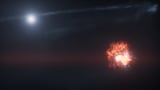
Hubble Space Telescope observations have resolved a decades-long mystery by showing dusty debris from two separate colossal collisions near the young star Fomalhaut, explaining a bright spot once thought to be a planet.
This rare, real-time view lets scientists study violent planetary formation processes directly and could inform how Earth-like planets and moons formed in our own solar system.
The Science study notes two distinct, giant collisions within roughly two decades are highly unexpected, suggesting collisions may be more common in young planetary systems and warrant ongoing monitoring.
The research team is led by Paul Kalas of UC Berkeley with co-author Mark Wyatt of the University of Cambridge, in a collaboration spanning NASA, ESA, and institutions including the Space Telescope Science Institute and Lockheed Martin Space.
Additional collaborators include Joshua Lovell of the Harvard-Smithsonian Center for Astrophysics and Meredith MacGregor of Johns Hopkins University, with insights from the AP and Science journals.
The Science paper, published in 2025, assigns the work to Kalas and colleagues and notes ongoing observations to understand the circumstellar environment and the mechanisms driving the collisions.
Multiple independent analyses confirm the detections, and follow-up observations with the James Webb Space Telescope’s NIRCam are planned to obtain color data on the dust grains and determine their composition and size.
JWST/NIRCam will provide multi-spectral views to assess dust grain size, composition, and potential water ice in the debris.
Scientists emphasize the need for continued observations to track the evolution of the dust cloud and extract more details about the colliding bodies and disk dynamics.
Ongoing tracking will help determine whether such smashups are more frequent than previously believed and what they reveal about planetary formation.
Long-baseline observations and JWST will continue to monitor the Fomalhaut system as Hubble’s capabilities wane, highlighting the complementary roles of these observatories.
Findings have broader implications for understanding planetesimal composition and the early stages of planetary systems, potentially reducing the need for expensive missions to study collisions.
Summary based on 16 sources
Get a daily email with more World News stories
Sources
Yahoo News • Dec 18, 2025
Hubble Space Telescope spies dusty debris from two cosmic collisions

AP News • Dec 18, 2025
Hubble images reveal the aftermath of two cosmic collisions | AP News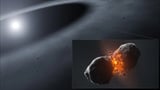
Popular Science • Dec 18, 2025
First-of-its-kind cosmic collision spotted 25 light-years from Earth