Europa's Hidden Ocean: New Study Questions Habitability Amidst Geologically Quiet Seafloor
January 6, 2026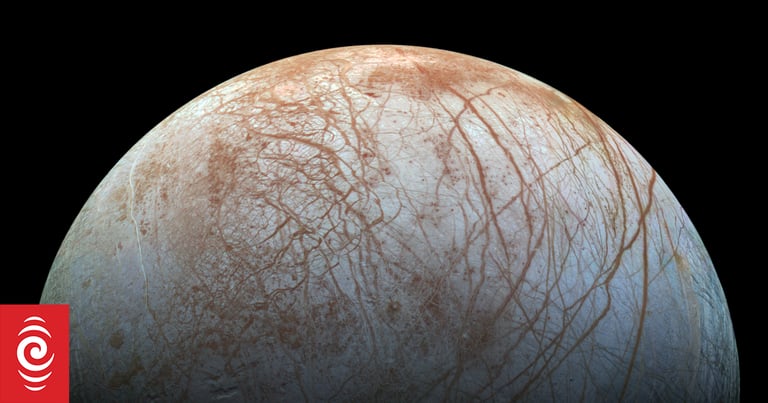

Authors and affiliations include Paul Byrne, Philip Skemer, Jeffrey Catalano, Douglas Wiens, Henry Dawson, and the McDonnell Center for the Space Sciences.
Europa remains the leading candidate in the search for extraterrestrial life due to its subsurface ocean beneath an icy shell, but a new study suggests it may lack the seafloor tectonic activity thought to support habitability.
The assessment weighs factors such as Europa’s size, rocky core, and the strong gravitational influence of Jupiter, concluding there is limited underwater faulting, ridges, trenches, volcanoes, or hydrothermal systems.
Despite the potential absence of active geology, scientists remain optimistic that the Europa Clipper mission will yield measurements on ice-shell thickness, ocean depth, and overall structure to better assess habitability.
Estimates place Europa’s ice shell at roughly 15 to 25 kilometers thick with an ocean possibly 60 to 150 kilometers deep, containing more water than Earth despite Europa being smaller than the Moon.
Europa’s diameter is about 3,100 kilometers, with an ocean that could be twice Earth’s total water volume, underscoring the vastness of its hidden ocean.
Past tidal heating may have occurred, but current gravitational tides appear too weak to drive significant seafloor activity today.
A geologically dead seafloor does not rule out life entirely, but it shifts likely habitats and energy sources, guiding future search strategies for Europa.
Europa remains the best-known candidate for life, with upcoming data from the Europa Clipper potentially revising our understanding.
Nature Communications reference for the study is 10.1038/s41467-025-67151-3.
The study examines how rock-water interactions that generate nutrients and energy for life on Earth rely on tectonic fracturing and faulting, raising questions about potential energy sources on a geologically quiet Europa.
Heat from Europa’s core likely escaped long ago, and Jupiter’s stable orbit minimizes tidal heating compared with more active moons, reducing energy availability at the seafloor.
Summary based on 11 sources
Get a daily email with more Science stories
Sources
Yahoo News • Jan 6, 2026
Study casts doubt on potential for life on Jupiter's moon Europa
Phys.org • Jan 6, 2026
Jupiter's moon Europa lacks the undersea activity needed to support life, study suggests
The Jerusalem Post | JPost.com • Jan 6, 2026
New discoveries cast doubt on life on Jupiter's moon | The Jerusalem Post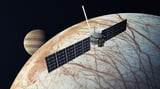
The Times • Jan 6, 2026
Mission seeking life on Jupiter ice moon ‘likely’ to be in vain