ISS Achieves Milestones in Cancer Therapy, Space Manufacturing, and Solar Research in 2025
January 16, 2026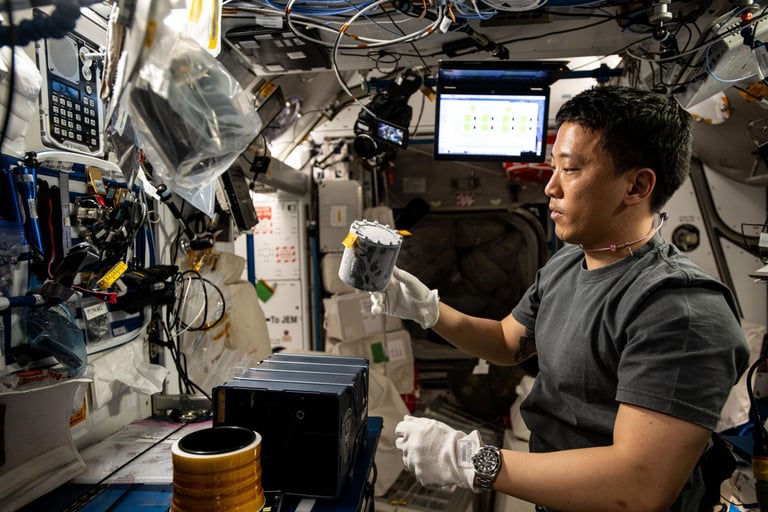

A solar coronagraph on the ISS produced the first images of the Sun’s outer atmosphere, enabling study of solar wind heating and acceleration and their impact on Earth and space-based technologies.
Three experiments from the Blue Ghost Mission-1, enabled by prior ISS research, advanced space weather monitoring, radiation-resilient computer recovery, and lunar navigation systems.
For the first time, all eight ISS docking ports were occupied simultaneously by crew and cargo spacecraft, including JAXA’s HTV-X1 and Northrop Grumman’s Cygnus XL, underscoring international collaboration and commercial partnerships.
The article frames the ISS as a cornerstone for future deep-space exploration, calling for ongoing international collaboration and commercialization to expand research capabilities with a forward-looking view for 2026.
Astronaut Butch Wilmore conducted spacewalks to collect microbiological samples near life-support vents, studying microorganism survival in space and reassessing biosafety for future crewed missions to the Moon and Mars.
The International Space Station logged over 5,800 orbits in 2025 and supported more than 750 experiments and technology demonstrations, spanning exploration, Earth benefits, and commercial opportunities in low Earth orbit.
ISS research contributed to a newly FDA-approved injectable cancer therapy, with protein crystal growth studies informing particle sizes and delivery methods that could reduce costs and shorten treatment times.
Eight medical implants for nerve regeneration were 3D-printed aboard the ISS for preclinical Earth testing, showcasing microgravity’s role in producing uniform, stable biomedical structures and advancing in-space manufacturing.
Summary based on 1 source
Get a daily email with more Space News stories
Source
NASA • Jan 16, 2026
Out of This World Discoveries: Space Station Research in 2025 - NASA