Earliest Spectroscopically Confirmed Supernova Unveiled by JWST: A Glimpse into the Early Universe
January 16, 2026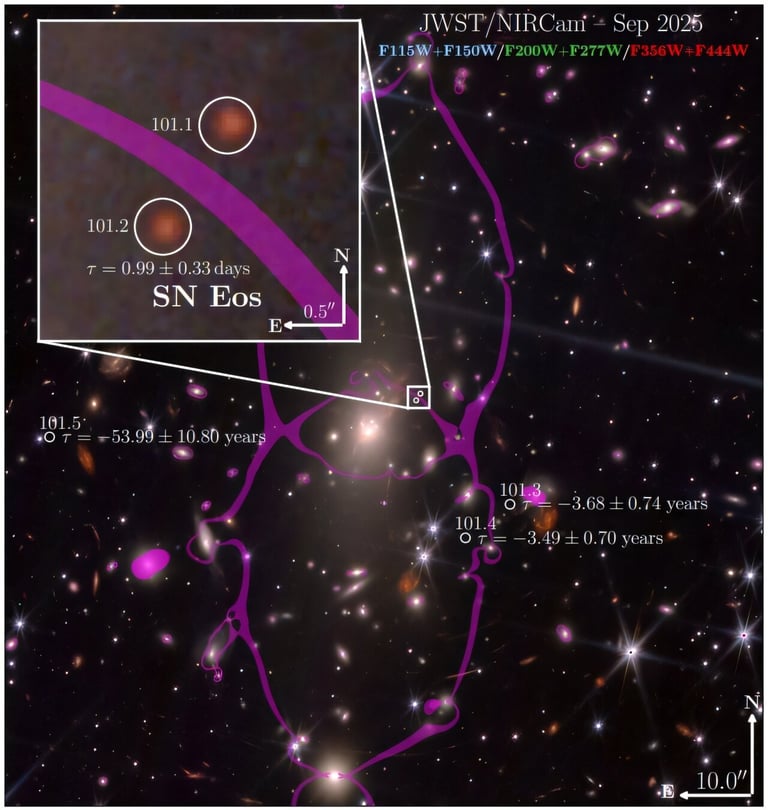

SN Eos is identified as a metal-poor Type II-P (IIP) supernova with bright, rising far-ultraviolet emission in the rest frame and a late-time plateau, signaling a classic IIP light curve in an extremely low-metallicity environment.
Spectroscopy confirms SN Eos originated from a very massive star with metallicity below ten percent of the Sun’s, consistent with star formation in the early universe.
Gravitational lensing by a foreground galaxy cluster magnified the explosion by tens of times, enabling a detailed look at the event.
This observation offers a rare view of individual stars at extreme distances, shedding light on the composition and evolution of early galaxies beyond unresolved stellar populations.
The event occurred near the end of the epoch of reionisation, a period when the universe became transparent to photons, allowing such distant light to reach Earth.
The finding was reported in arXiv:2601.04156, led by David A. Coulter and collaborators from Johns Hopkins University, with communication in January 2026.
SN Eos lies in a very faint Lyman-alpha emitting galaxy and appears as multiple lensed images within the MACS 1931.8-2635 cluster field.
The supernova has a spectroscopic redshift of 5.133, exploding when the universe was about one billion years old, shortly after reionisation.
The discovery provides direct insights into early stellar populations and the rapid lifecycles of massive stars, refining our understanding of star formation right after reionisation.
The host environment shows metal abundance below 10% of solar, indicating an extremely metal-poor progenitor.
SN Eos is a strongly lensed, spectroscopically confirmed Type II supernova discovered in the early universe with the James Webb Space Telescope (JWST).
JWST observations of SN Eos place it at about one billion years after the Big Bang, making it the earliest spectroscopically confirmed supernova.
Summary based on 2 sources
Get a daily email with more Science stories
Sources
Phys.org • Jan 15, 2026
Ancient Type II supernova discovered from universe's first billion years
New Scientist • Jan 15, 2026
Earliest ever supernova sheds light on the first stars