New Census Reveals Surprising Black Hole Activity in Smaller Galaxies
January 17, 2026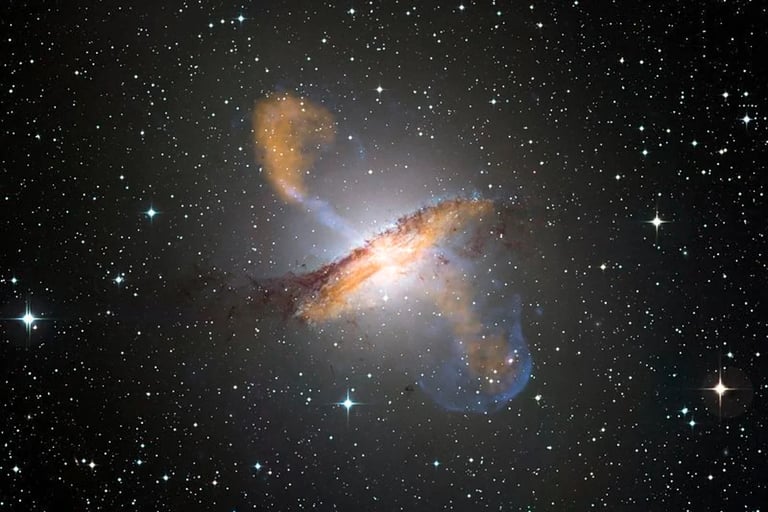

To enable independent verification and further research, the team is releasing processed measurements for the scientific community.
Presented at the American Astronomical Society meeting, researchers from the Harvard & Smithsonian Center for Astrophysics and the University of North Carolina at Chapel Hill used optical, infrared, and X-ray data to detect faint black hole activity while suppressing glare from star formation.
Even with improved detection, there remains uncertainty for the faintest accreting black holes, so reported percentages are approximate and may shift with future observations.
The results bolster the view that the Milky Way formed in part through mergers with dwarf galaxies whose black holes may have contributed to its central supermassive black hole, providing a clearer baseline for black hole formation and galaxy evolution models.
A new census shows a rising, mass-dependent rate of active galactic nuclei, with a sharp increase among Milky Way–mass galaxies, suggesting that massive black holes may be more common in smaller galaxies than previously believed.
Across more than 8,000 nearby galaxies, roughly 2 to 5 percent of dwarf galaxies host an AGN, translating to about 20–50 per 1,000 objects.
Summary based on 1 source