Hubble Captures Longest, Fastest Jet from Massive Protostar in Sagittarius
January 18, 2026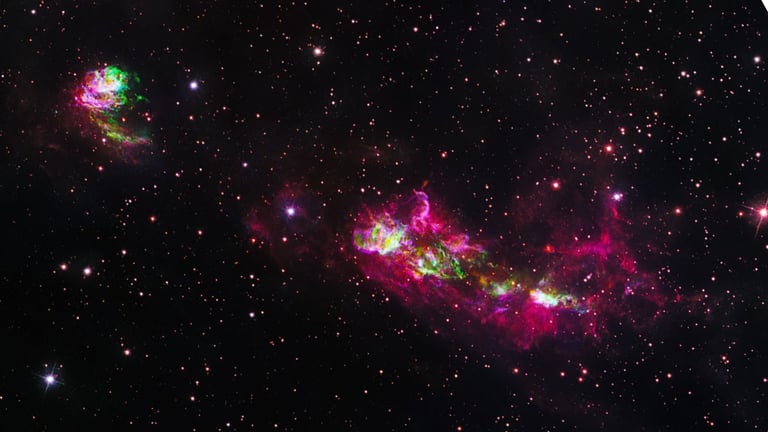

This discovery showcases a very massive young star driving an HH jet, highlighting the diversity of star formation processes.
HH objects like HH 80/81 differ from those around low-mass stars, making this jet distinctive as it is driven by a young massive star.
Hubble’s Wide Field Camera 3 enabled high-resolution analysis of the jets, revealing fine details, movements, and structural changes.
The jet travels at approximately 2.2 million miles per hour (3.5 million km/h), making it the fastest outflow observed to date.
The outflow is driven by magnetic-field–accelerated plasma channeled from the protostar’s accretion disk, illustrating how accretion and jet formation operate in massive young stars.
HH 80/81 constitute the brightest known Herbig-Haro objects with an outflow spanning roughly 32 light-years, the largest protostellar outflow observed.
A newly observed jet from the massive protostar IRAS 18162-2048 extends about 32 light-years, making it the longest outflow seen from a forming star.
NASA’s Hubble Space Telescope captured an image of a jet of gas from the forming star system IRAS 18162-2048, associated with HH 80 and HH 81.
Located about 5,500 light-years away in the Sagittarius constellation, parts of the HH 80/81 outflow exceed 1,000 km/s, the fastest recorded for a young stellar object in both radio and visual wavelengths.
This observation, captured with Hubble’s Wide Field Camera 3, highlights the ongoing scientific value of the Hubble Space Telescope after 36 years in service.
The Herbig-Haro objects HH 80 and HH 81 are bright jets formed when protostellar outflows shock surrounding gas, creating luminous glows in interstellar clouds.
The image permits study of fine structural changes in the jet and underscores the enduring relevance of the Hubble Space Telescope for astronomical research.
Summary based on 2 sources
Get a daily email with more Space News stories
Sources
NASA • Jan 18, 2026
Hubble Spies Stellar Blast Setting Clouds Ablaze - NASA
Space • Jan 18, 2026
Hubble Telescope watches star blast out jet of hot gas 32 light-years long