James Webb Telescope Unveils 'Eye of Sauron': A Stunning View of the Helix Nebula
January 20, 2026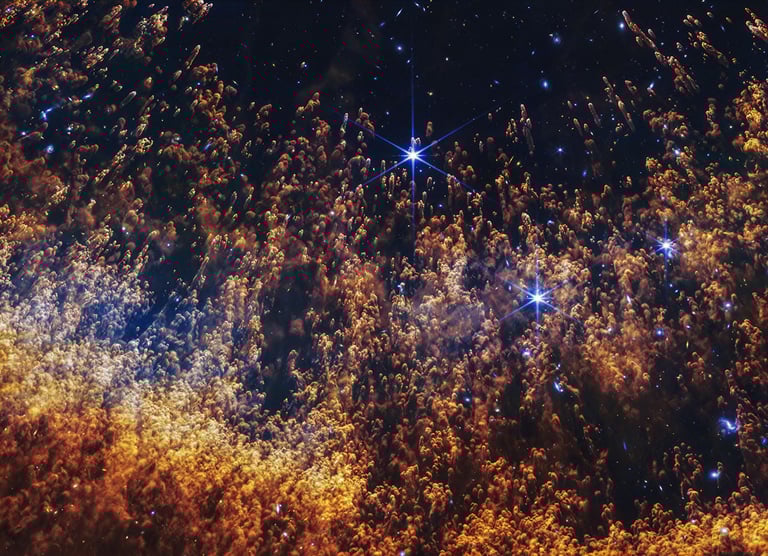

NASA’s James Webb Space Telescope provides a high-resolution, near-infrared view of the Helix Nebula, revealing comet-like knots, fast stellar winds, and layers of gas shed by a dying star interacting with its surroundings.
Located about 650 light-years away in Aquarius, the Helix Nebula’s striking appearance has earned it comparisons to the Eye of Sauron as a well-studied planetary nebula.
The image illustrates hot gas from the central white dwarf colliding with slower, cooler gas, shaping the nebula’s structure and highlighting gas recycling into the cosmos.
The study underscores how dying stars supply raw materials for future generations of stars and planets, reinforcing the scientific value of understanding stellar death and material recycling in the galaxy.
Although called a planetary nebula, it is not related to planets; it is a phenomenon from dying stars shedding outer layers.
The image uses color to convey temperature and chemistry: blue for the hottest gas near the white dwarf, yellow for cooler gas where hydrogen molecules form, and red at the outer edges for the coldest material and dust formation zones.
A standout feature is the cometary knots—dense, dusty structures formed by the interaction of hot gas with cooler surrounding material.
Webb’s observations build on prior Spitzer findings, revealing how complex molecules form in shielded regions within the nebula, including dark pockets amid glowing gas.
The view emphasizes the contrast among hot ionized gas near the white dwarf, cooler molecular hydrogen farther out, and dust-enshrouded pockets where complex molecules may form, signaling raw material for future planet formation.
Summary based on 6 sources
Get a daily email with more Science stories
Sources
Ars Technica • Jan 20, 2026
Webb reveals a planetary nebula with phenomenal clarity, and it is spectacular
Yahoo! • Jan 20, 2026
Earth is having some issues, so let's enjoy the Webb telescope's new nebula image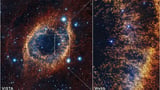
Gizmodo • Jan 20, 2026
Extreme Closeup of the ‘Eye of God’ Reveals Fiery Pillars in Stunning Detail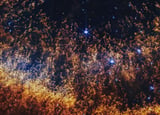
Phys.org • Jan 20, 2026
Intricacies of Helix Nebula revealed with Webb