ESA's EPS-Sterna Satellites to Revolutionize Arctic Weather Monitoring by 2029
January 25, 2026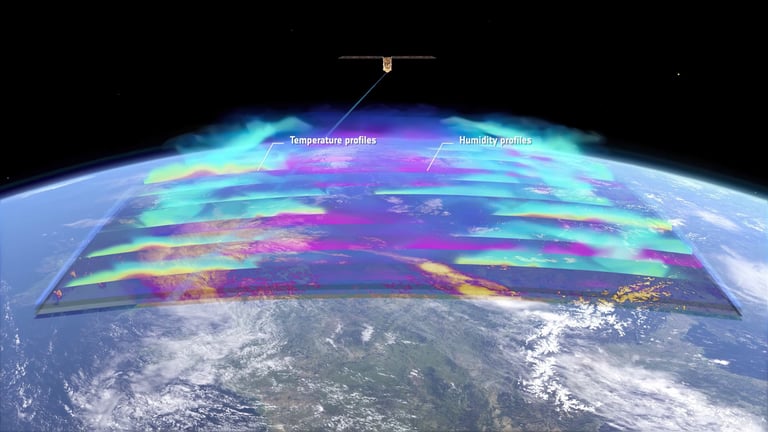

The EPS-Sterna constellation is planned to include six satellites, with replenishments during its lifetime to ensure data continuity until at least 2042, plus two spares, for a total of twenty satellites.
Launched in August 2024 and completed within three years on a tight budget, the mission demonstrated that a New Space approach can deliver Earth observation satellites quickly and affordably while meeting operational needs.
The mission achieved its core aim of validating a New Space approach for building small, cost-constrained satellites capable of Earth observation on an accelerated development timeline.
Eumetsat will oversee EPS-Sterna procurement, mirroring the collaboration model used for Meteosat and MetOp missions, with the first satellites targeted for launch in 2029.
The satellite carries a cross-track scanning microwave radiometer to measure atmospheric humidity and temperature, data which are already being assimilated into ECMWF forecasts and complement larger satellites operated by Eumetsat, NOAA, and CMA.
Equipped with a 19-channel cross-track scanning microwave radiometer, the Arctic Weather Satellite provides high-resolution humidity and temperature soundings under all weather conditions, enhancing Arctic and global atmospheric profiling.
The first EPS-Sterna satellites are planned to launch in 2029, with global observations and data available within about an hour and revisit times under three hours for the same location, dramatically improving monitoring of rapidly evolving weather and severe events, especially in the Arctic and its influence on Europe.
An Arctic Weather Satellite prototype from the European Space Agency demonstrated the feasibility of a constellation of similar satellites to provide frequent, near-real-time observations for weather forecasting in the Arctic.
The Arctic Weather Satellite’s operational use beyond its initial goals and the ESA–Eumetsat collaboration signal a new era in polar observation and climate-related weather forecasting, with the Latin name Sterna reflecting the polar-orbiting nature of the constellation.
ECMWF has already assimilated the satellite’s data into weather forecasts, indicating the data quality meets operational needs despite the mission’s prototype status.
The initiative represents a cooperative effort among ESA, Eumetsat, and other meteorological agencies to advance Earth observation through a frequent, reusable constellation.
Eumetsat has confirmed that the EPS-Sterna plan will proceed with six satellites in total (two spares) and a replenishment strategy through 2042, with procurement led similarly to Meteosat and MetOp missions.
Summary based on 2 sources
Get a daily email with more Science stories
Sources
Phys.org • Jan 25, 2026
Arctic Weather Satellite paves way for constellation observation
Arctic Weather Satellite paves way for constellation
Arctic Weather Satellite paves way for constellation