JWST Uncovers First Methyl Radical in Distant Galaxy, Sheds Light on Cosmic Prebiotic Chemistry
February 15, 2026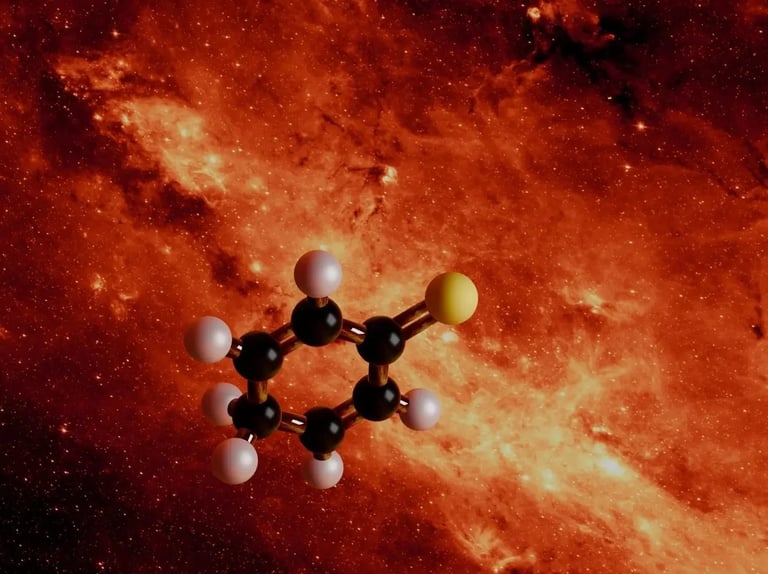

The results imply deeply buried galactic nuclei may function as large-scale chemical factories, influencing galactic chemical evolution over time.
Lead author is Dr. Ismael García Bernete, with collaborators from CSIC, INTA, University of Oxford, and University of Alcalá; findings published in Nature Astronomy.
The study showcases JWST’s ability to probe hidden regions of the universe and advance understanding of prebiotic chemistry pathways in extreme environments.
PAH models indicate cosmic-ray fragmentation of PAHs and carbon-rich dust grains as a mechanism releasing organics into gas, consistent with high cosmic-ray ionization in AGNs.
Cosmic rays are a key driver of chemical richness, breaking apart organics to release smaller molecules, with a demonstrated link between hydrocarbon abundance and cosmic-ray ionization in similar galaxies.
Using JWST’s NIRSpec and MIRI, researchers quantified abundances and temperatures of chemical species in the galactic nucleus, detecting hydrocarbons and marking the first identification of the methyl radical in another galaxy, along with benzene, methane, acetylene, diacetylene, and triacetylene.
JWST observations of the ultra-luminous infrared galaxy IRAS 07251-0248 reveal a rich inventory of organic molecules in both gas and solid form, suggesting that the building blocks of life may originate in galactic nuclei.
Spectroscopic data from 3–28 microns show a diverse mix of small organic molecules in the hidden core of IRAS 07251-0248.
The study adds to a broader view that organic materials can form and persist in space, offering new ways to study molecule formation in extreme environments and guiding the search for extraterrestrial life.
While small organic molecules are not life themselves, they could play a crucial role in prebiotic chemistry and the eventual formation of amino acids and nucleotides, contributing to galactic chemical evolution.
Both gaseous molecules and solid organics, such as carbonaceous grains and water ices, were found in unusually high abundances, indicating a continuous source of carbon fueling a rich chemical network in the nucleus.
Large quantities of solid materials like carbon-rich grains and water ices were detected in the obscured nucleus.
Summary based on 2 sources
Get a daily email with more Science stories
Sources
ScienceDaily • Feb 12, 2026
James Webb reveals extraordinary organic molecules in an ultra luminous infrared galaxy
Universe Today • Feb 15, 2026
Webb Reveals a Plethora of Organic Molecules in a Bright Local Infrared Galaxy