Atlas V Rocket to Launch Record-Breaking 29 Satellites for Amazon Leo Internet Constellation
April 3, 2026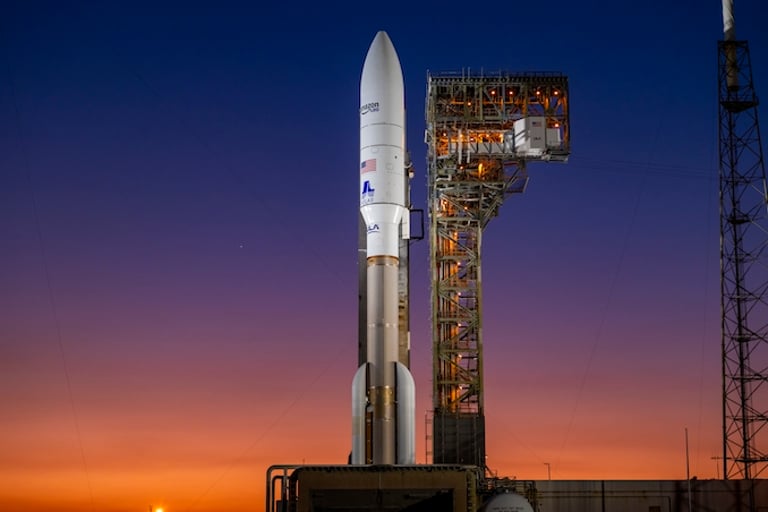

A ULA Atlas V rocket will launch its heaviest-ever payload on a mission designated Amazon Leo 5, from Space Launch Complex 41, carrying 29 Amazon Leo satellites.
This marks the first Atlas V mission to deploy 29 satellites for Amazon Leo, following previous Atlas V payloads that included missions using SpaceX Falcon 9 and Ariane 6.
The LIVestream will invite viewer interaction on YouTube, with notes on commenting and display name requirements.
Amazon Leo, formerly Project Kuiper, aims to build a roughly 3,200-satellite low Earth orbit internet constellation to compete with SpaceX’s Starlink.
The 29 satellites will begin deployment about 21 minutes after liftoff, with the Centaur’s RL10C-1-1 upper stage reigniting roughly 55 minutes after launch for a disposal burn.
This mission is called Amazon Leo 5 by ULA and LA-05 by Amazon, representing the fifth operational Amazon Leo launch and the ninth overall in the constellation.
Amazon credited the engine’s performance margin and an expanded four-level dispenser configuration as key factors enabling the larger payload.
The extra satellites are enabled by a larger upper-stage dispenser and the RL10C-1-1 engine on the Centaur, enhancing Atlas V’s payload capacity.
ULA conducted a launch readiness review in late March, then rolled to the pad before a weather delay forced a rollback and subsequent return to the pad.
To date, 212 Amazon Leo satellites have reached orbit across eight launches, with two prototypes launched in 2023 not counted among the eight.
Liftoff is scheduled for early Saturday morning, April 4, at 1:45 a.m. Eastern Time, on a north-easterly trajectory from Cape Canaveral.
LA-05 represents a major milestone for both Amazon Leo and Atlas V, reflecting extensive safety and engineering work to accommodate the heavier payload.
Summary based on 2 sources