Students Discover Oldest Metal-Poor Star Migrated from Large Magellanic Cloud to Milky Way
April 4, 2026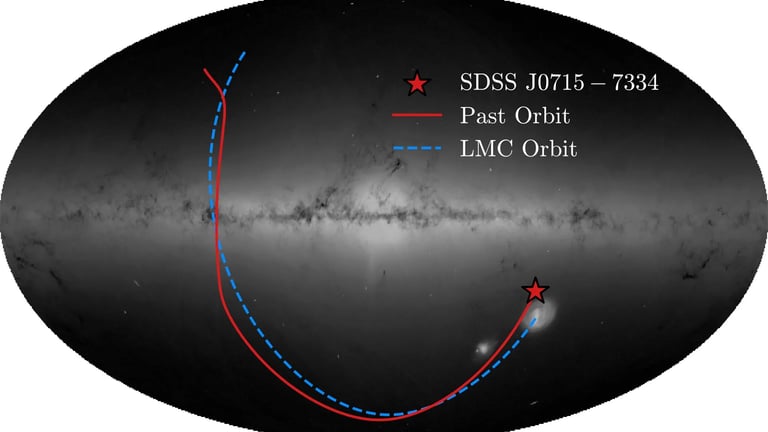

Using Gaia mission data in conjunction with SDSS observations, researchers traced the star’s distance and past trajectory to map its journey across galaxies.
Spectral analysis shows the star is almost entirely hydrogen and helium with undetectable carbon, pointing to a formation path with minimal cosmic dust and making it exceptionally rare.
The discovery began during a Spring Break observing trip to Carnegie Science’s Las Campanas Observatory in Chile, where initial observations on a spring day in 2025 revealed the star’s unusual properties and redirected the students’ project.
A group of ten undergraduate students at the University of Chicago, guided by Professor Alex Ji and teaching assistants, identified one of the oldest known stars using Sloan Digital Sky Survey data.
The students’ work is poised to influence their careers, with Orrantia and Do planning to pursue astronomy graduate studies, while the SDSS-V program continues to emphasize student involvement and discovery.
The star, designated SDSSJ0715-7334, did not form in the Milky Way but originated in the Large Magellanic Cloud and migrated into our galaxy billions of years ago, heralded as an ancient immigrant.
This achievement underscores how large-scale surveys like SDSS and Gaia empower students and researchers to participate directly in major astronomical discoveries.
Spectral data reveal the star is extraordinarily metal-poor—only 0.005 percent as metal-rich as the Sun—marking it as the most metal-poor star observed to date and signaling formation in the early universe.
Summary based on 1 source
Get a daily email with more Science stories
Source
ScienceDaily • Apr 4, 2026
Students found a star from the dawn of the universe drifting into the Milky Way