College Students' Cameras to Launch on NASA Mission, Pioneering Space Contributions
April 7, 2026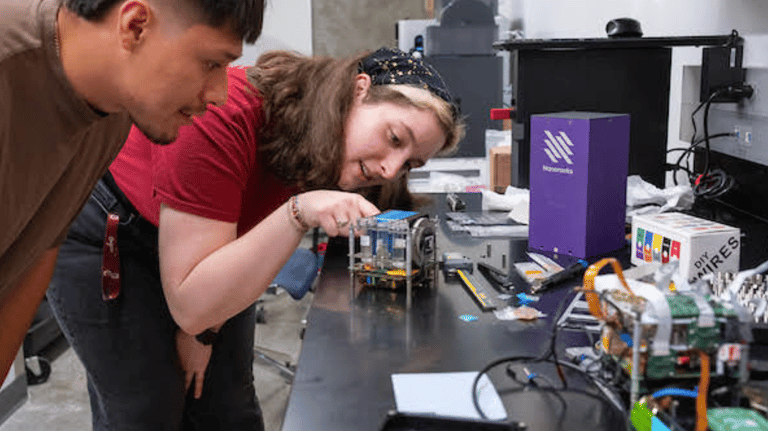

Two College of Charleston astrophysics students — Eva Godwin and Gael Gonzalez — developed a liquid lens–based optical camera and an ultraviolet camera destined for the International Space Station as part of a NASA payload, marking the college’s first space-based contribution.
The cameras will accompany the Northrop Grumman Cygnus-24 cargo mission, scheduled to launch from Kennedy Space Center aboard a SpaceX Falcon 9 on April 8 at 8:51 a.m. local time.
The mission is a six-month data collection effort in space, with data analysis planned after the payload returns to Earth in the fall.
All three students involved plan to pursue Ph.D. programs, underscoring the project’s impact on early-career researchers and the educational value of undergraduate participation.
Godwin, a physics and astrophysics major from York County, will begin graduate studies next month and has prior teaching and substitute experience.
Gonzalez, a first-generation college student from Loris, graduates soon and hopes to work with NASA after graduate school; he had not visited NASA’s Kennedy Space Center before this mission.
The liquid lens camera is designed to monitor microscopic life forms, while the ultraviolet camera studies the relationship between young stars and exoplanet atmospheres, tracking stellar activity.
Under the guidance of Professor Joe Carson and Universidad de Chile’s Marcos Díaz, Godwin and Gonzalez developed the liquid lens camera and the ultraviolet camera to study biological specimens and stellar activity.
The students are excited to participate in an actual space mission and to engage with facilities like Kennedy Space Center and NASA.
The mission is a stepping stone for broader capabilities, with two additional cameras planned to fly later in the year aboard a satellite to continue the research.
The equipment is headed to Kennedy Space Center for an April launch, with about six months of in-space data collection and post-mission analysis after return.
The College of Charleston team will travel to Florida to observe the launch, which is set for a Wednesday from Cape Canaveral Space Force Station.
Summary based on 3 sources