NASA's Deep Space Network Achieves Historic Artemis II Moon Mission Signal Success
April 9, 2026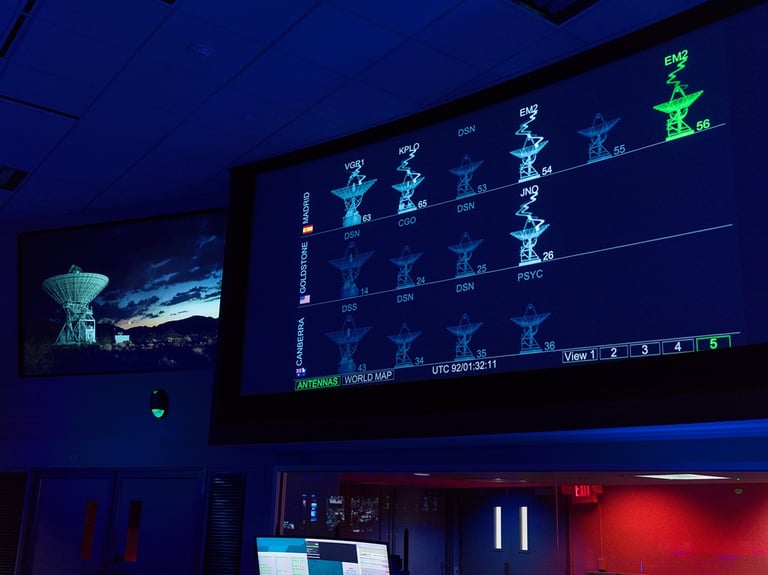

Additional Artemis II information is available on NASA’s official mission page.
For ongoing mission visibility, the DSN Now visualization tool provides 24/7 monitoring of DSN missions.
NASA’s Deep Space Network (DSN) successfully acquired a signal from Artemis II during a Moon mission communications test, marking a deep-space contact from the crewed mission.
Artemis II launched on the evening of April 1, 2026, with initial communications handled by the Near Space Network before DSN took over for deep-space contact—the first crewed deep-space link in over 50 years.
DSN is operated by NASA’s Jet Propulsion Laboratory for NASA’s Space Communications and Navigation (SCaN) program and is distributed across three complexes in Goldstone, Madrid, and Canberra, each with multiple antennas supporting many missions.
Two Madrid DSN antennas, Deep Space Station 54 and 56, were shown communicating with Artemis II, with signals labeled EM2 (Exploration Mission 2) and ART2 (Artemis II).
Beyond Artemis II, the DSN supports tracking, command transmission, and data reception for distant spacecraft and a broad range of solar system missions.
The Space Flight Operations Facility at JPL coordinates DSN operations, with JPL managed by Caltech for NASA.
A peak in the DSN ground computer screen confirmed the radio frequency signal from the Artemis II crewed Moon mission was being received.
Summary based on 2 sources
Get a daily email with more Science stories
Sources
NASA Science • Apr 9, 2026
The Deep Space Network Acquires Artemis II Signal - NASA Science
NASA Science • Apr 9, 2026
The Deep Space Network Acquires Artemis II Signal - NASA Science