Comet R3 Pan-STARRS: Spectacular Sky Show Nears in April 2026, Brightens to Magnitude 0
April 17, 2026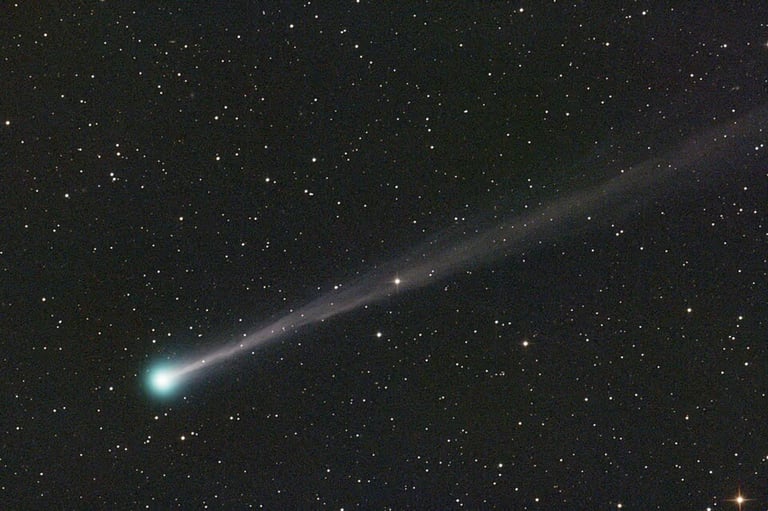

NASA and Space.com project Comet R3 Pan-STARRS will reach its closest Sun approach in mid-April 2026 and will pass closest to Earth in late April, with the Earth encounter expected to come within about 44 million miles.
As it nears perihelion this April, the comet has brightened to around magnitude +4.3 and could reach magnitude 0 at or near perihelion, making it one of the brighter comets in recent memory.
Observers report a green coma with cyanogen gas and a long dust tail, with visibility improving for dawn observers in mid-northern latitudes.
For the best viewing, seek dark-sky spots low on the eastern or northeastern horizon before sunrise, using binoculars or a small telescope for clearer detail.
After perihelion, the comet will travel through Eridanus toward Orion and past Sirius, with dusk viewing becoming more challenging due to geometry; mid-northern latitudes with dark skies offer the best chances.
Stay tuned to Daily Voice Quincy for updates on viewing conditions, as conditions can change.
Discovered in 2025 by the Pan-STARRS telescope in Hawaii, the object likely has a long orbital period of about 170,000 years and features a greenish coma with a faint tail.
Space-based observations from SOHO’s LASCO C3 and GOES-19’s CCOR-1 will monitor the comet’s perihelion evolution as it approaches and recedes from the Sun.
From late April into May, the comet’s path will pass near the Orion Nebula (M42) on May 11, offering a potential photo opportunity for observers.
Looking further into 2026 and 2027, the comet will traverse Lepus on its journey out of the solar system, appearing as a long-lasting, interstellar-leaning visitor from our viewpoint.
Summary based on 2 sources
Get a daily email with more Space News stories
Sources
Quincy Daily Voice • Apr 17, 2026
Rare Naked-Eye Comet Approaches Peak Brightness: When To Watch
Universe Today • Apr 17, 2026
Comet R3 PanSTARRS at Perihelion