NASA's New Thruster Breaks Power Record, Paving Way for Crewed Mars Missions
May 2, 2026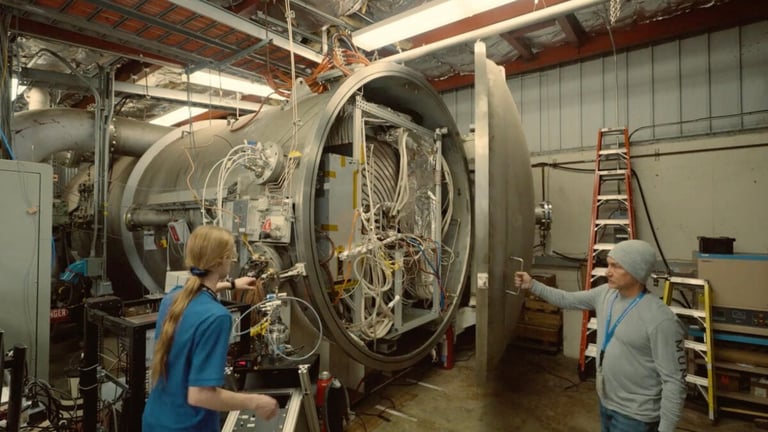


Tests were conducted in a 26-foot-long water-cooled vacuum chamber at NASA’s Jet Propulsion Laboratory, producing temperatures above 5,000 degrees Fahrenheit with a bright red plume and white glow indicating electrode activity.
NASA recently demonstrated a lithium-fed magnetoplasmadynamic (MPD) thruster at up to 120 kilowatts, the highest power level reached in U.S. electric propulsion tests.
The MPD thruster accelerates lithium plasma using lithium vapor, high currents, and a magnetic field, potentially delivering higher thrust at high power than current solar-powered electric thrusters.
JPL’s lithium-plasma thruster achieved 120 kilowatts, setting a new U.S. power record for this class of engines.
NASA Administrator emphasizes that the test marks real progress toward sending an American astronaut to Mars, with ongoing refinements for future high-power demonstrations.
The propulsion system must endure extreme temperatures—over 2,800°C (5,000°F)—and could shorten mission timelines by reducing fuel mass.
Launching crewed Mars missions could require 2 to 4 megawatts of power distributed across several MPD thrusters, with operation lasting tens of thousands of hours, presenting thermal and durability challenges that ongoing tests aim to address.
NASA estimates a human Mars mission would need 2 to 4 megawatts of power, spread over multiple thrusters and requiring more than 23,000 hours of operation, roughly 2.6 years.
Future demonstrations aim to validate performance and push power levels toward 500 kilowatts to 1 megawatt per thruster in coming years.
JPL has collaborated with Princeton University and NASA Glenn Research Center on the MPD thruster for about two and a half years under the Space Nuclear Propulsion project, targeting megawatt-class nuclear electric propulsion for crewed Mars missions.
Officials say the test confirmed thruster functionality and the targeted high power, establishing a testbed to address scaling challenges for future systems.
If developed, the MPD thruster could lower launch mass and enable larger payloads by delivering higher power when paired with a nuclear power source.
Summary based on 2 sources
Get a daily email with more Tech stories
Sources
Gizmodo • May 1, 2026
NASA’s Lithium-Fed Nuclear Thruster Flares to Life in First of Its Kind Test
Slashdot • May 2, 2026
New Lithium-Plasma Engine Passes Key Mars Propulsion Test - Slashdot