JWST Unveils Cosmic Buckyballs' Role in Nebula Chemistry and Origins of Life
May 10, 2026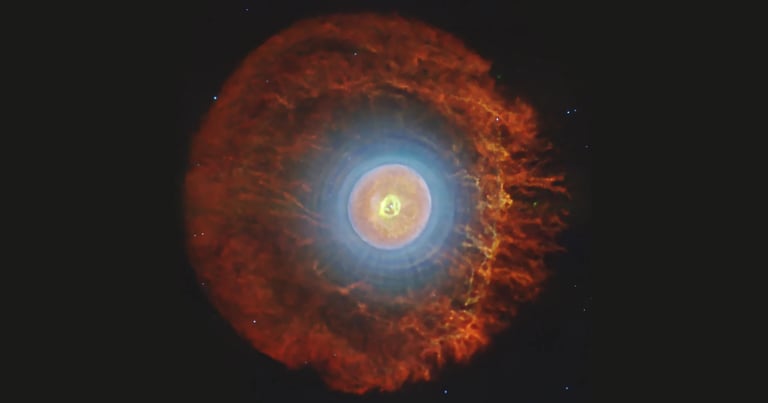

Researchers, including Morgan Giese and Dries Van De Putte, note that the buckyballs’ organized, spherical distribution and bright emission are revealing new details about the nebula’s structure and chemistry.
The study is part of JWST Cycle 3 GO-4076, aiming to quantify how large molecules interact with their radiative environment, with support from the Canadian Space Agency, NSERC, and Western University.
Western University researchers led by Jan Cami have confirmed cosmic buckyballs (C60) with the James Webb Space Telescope, revisiting the 2010 Spitzer discovery.
Buckyballs are carbon-60 molecules named after Buckminster Fuller, offering insights into carbon chemistry, stellar evolution, and the processing of organics in extreme environments.
New JWST data, including high-resolution MIRI images and IFU spectroscopy, reveal the carbon-rich chemistry of Tc 1 and shed light on how buckyballs form and glow in space.
Observations of Tc 1, a planetary nebula about 12,400 light-years away, show buckyballs concentrated in a thin spherical shell around the central star, indicating a hollow-sphere distribution.
The team expects multiple scientific papers detailing the nebula’s chemistry and buckyball formation mechanisms, with analyses continuing over the coming years.
These findings highlight buckyballs’ importance for tracing carbon chemistry, interpreting unidentified space signals, and informing theories about the origins of life in the universe.
Summary based on 1 source