Possible Dark Matter Signature Found in Black Hole Merger: MIT Researchers' Novel Method
May 15, 2026

Researchers propose that dark matter could imprint discernible signatures on gravitational waves from merging black holes, via a dense dark-matter region surrounding spinning black holes that alters the waveform.
Applying their model to LVK data from the first three observing runs, the team analyzed 28 clearest events; 27 matched vacuum mergers while one event, GW190728, showed a possible dark-matter imprint.
GW190728 has a total black-hole mass of about 20 solar masses, and the model suggests it could originate from a black-hole binary merging within a dense dark-matter cloud, producing a waveform similar to the observed signal.
Researchers caution that the statistical significance is not sufficient to claim a detection and call for independent verification as LVK continues collecting data.
Findings were published on May 12 in Physical Review Letters by MIT researchers led by Josu Aurrekoetxea, summarized by science journalist Robert Lea.
This work emphasizes that it is not a dark-matter detection but a screening method to flag candidate signals for further confirmation with other techniques.
As LIGO’s fourth and fifth observing runs proceed, more detections will provide opportunities to search for a dark-matter fingerprint in gravitational waves.
The researchers built a model predicting the imprint and tested it against publicly available LIGO, Virgo, and KAGRA data, analyzing 28 clear signals from the first three runs.
Caveat: GW190728 is not a confirmed dark-matter detection but a potential hint guiding future investigations and follow-up studies.
This is a hint, not a confirmation, but marks the first time a gravitational-wave signal has been flagged as a potential dark-matter imprint using a rigorous physical model, showing the technique’s viability.
If confirmed, this approach could probe dark matter at smaller scales than previously possible and inform future Earth-based detectors as gravitational-wave observatories gain sensitivity.
The MIT-led team, including Josu Aurrekoetxea, proposes a novel method to detect dark matter not with terrestrial detectors but by examining gravitational waves from black-hole mergers.
Summary based on 3 sources
Get a daily email with more Space News stories
Sources
MIT News | Massachusetts Institute of Technology • May 12, 2026
A new way to spot signs of dark matter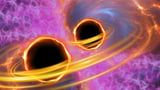
Space • May 15, 2026
We still can't see dark matter. But what if we can hear it?