NASA's Black Marble Reveals Dynamic Global Night Light Patterns: Brightening in Asia, Dimming in Europe
May 15, 2026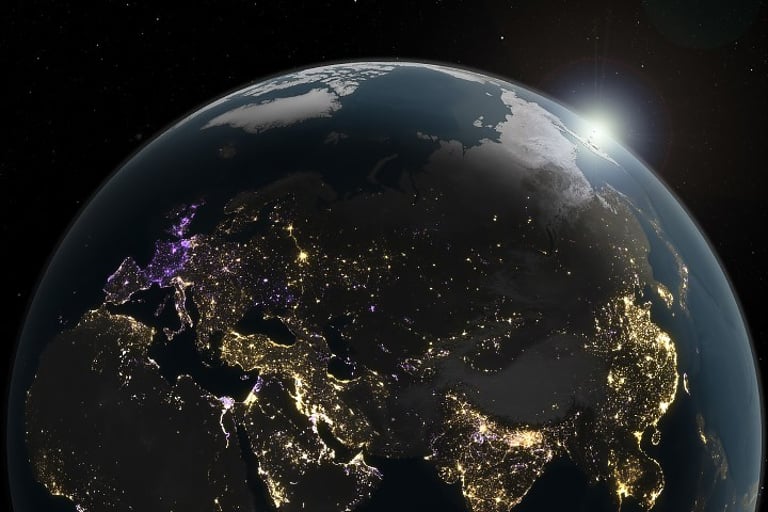

NASA analyzes nearly a decade of night-time light data from its Black Marble program (2014–2022) to map global changes in artificial lighting, revealing nuanced patterns rather than a uniform increase.
Using VIIRS-based observations from two satellites, researchers expected a steady global uptick but found regional brightening and dimming instead.
The study shows both intensification and reduction in artificial light across regions, illustrating a dynamic system driven by policy, economy, and technology.
In the United States, West Coast urban centers brightened with population growth, while parts of the East Coast dimmed due to energy efficiency and economic restructuring.
Overall, U.S. patterns show contrast: growth and brighter nights on the West Coast versus dimmer nights on the East Coast.
Dimming in Europe aligns with LED adoption and energy-conservation efforts, with a 2022 energy crisis tied to the Russia-Ukraine conflict contributing to further dimming.
Globally, brightening occurs in China and northern India due to urban development, while Europe experiences dimming from energy policies and the 2022 crisis.
The findings, published in Nature, frame night-time illumination as a dynamic system influenced by policy, economy, and technology.
The Nature study and NASA materials emphasize the bifurcated pattern of nighttime activity and the impact of energy policies on light pollution.
Nighttime-light data illuminate urban development and energy transitions, with NASA providing visuals and links to related publications for deeper exploration.
Key visualizations include global and Eastern Hemisphere maps showing brightening and dimming, with downloadable high-resolution maps and animations from NASA’s Visualization Studio.
Global radiance rose about one-third over the period, but regions varied, with notable increases in parts of China and northern India and reductions in Paris, London, and the Netherlands.
Summary based on 2 sources
Get a daily email with more Science stories
Sources
NASA Science • May 15, 2026
Picturing Earth in a New Light - NASA Science
CBS News • May 15, 2026
NASA maps show Earth's brightest and darkest regions at night