Roman Space Telescope to Unveil Hidden Neutron Stars and Black Holes in Milky Way
May 15, 2026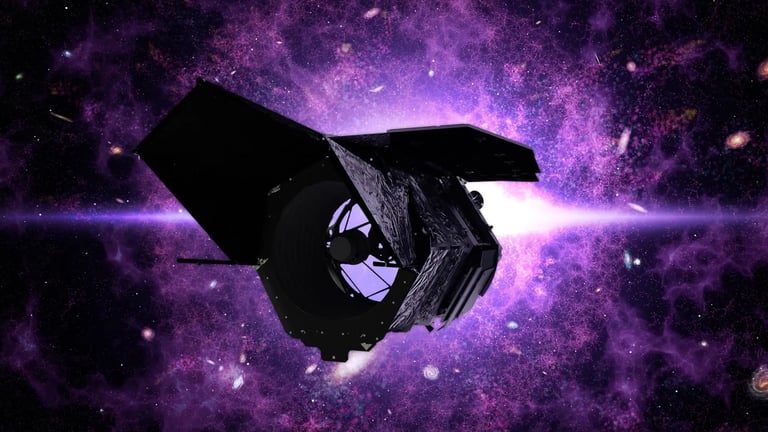

The study highlights an unexpected benefit: Roman’s astrometric precision could enable discoveries beyond exoplanet microlensing, including new detections of neutron stars and black holes.
If validated, Roman could provide the first large sample of isolated neutron stars discovered through gravity alone, transforming microlensing studies and our view of hidden galactic populations.
The Nancy Grace Roman Space Telescope could detect and study dozens of isolated neutron stars in the Milky Way via gravitational microlensing, according to a study in Astronomy and Astrophysics.
Even a small number of confirmed detections would significantly improve understanding of neutron-star mass distributions, kick velocities, and the overall population, which today is inferred from a much smaller sample of binary neutron stars.
NASA’s Roman Space Telescope is managed by Goddard Space Flight Center with participation from JPL, Caltech/IPAC, and STScI, along with industrial partners including BAE Systems, L3Harris, and Teledyne.
Current estimates place tens of millions to hundreds of millions of neutron stars in the Milky Way, but only a few thousand have been detected so far; Roman could reveal a much larger hidden population.
Neutron stars are extremely dense remnants of massive stars and are usually observed as pulsars or X-ray sources; Roman can detect them through photometric brightening and astrometric shifts from microlensing, enabling direct mass measurements in some cases.
The mission’s Galactic Bulge Time Domain Survey will repeatedly observe millions of stars to identify microlensing events and potentially weigh the unseen objects.
Mass measurements from astrometric microlensing could help determine whether a mass gap exists between neutron stars and black holes and reveal neutron-star birth kicks that propel them through the galaxy at high speeds.
Summary based on 2 sources
Get a daily email with more Space News stories
Sources
NASA • May 6, 2026
NASA’s Roman Poised to Transform Hunt for Elusive Neutron Stars - NASA
ScienceDaily • May 15, 2026
NASA’s Roman Space Telescope could reveal millions of invisible neutron stars