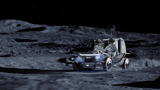
Lunar Outpost Pioneers Future of Moon Infrastructure with Advanced Autonomous Rovers
May 22, 2026

Industry optimism centers on NASA’s 2028 lunar landing timeline, with Eagle positioned as a backbone for building critical lunar infrastructure when humans return.
NASA’s Lunar Terrain Vehicle Services program and the Artemis surface campaign support a rover-as-a-service model, aligning with ongoing public-private collaboration to advance lunar mobility.
Four additional MAPP missions are in development, including Artemis 4 collaboration pairing a MAPP rover with an Artemis astronaut to study lunar regolith, signaling closer human-robot collaboration.
Lunar Outpost envisions rovers autonomously building and upgrading lunar infrastructure to sustain a permanent human presence, not merely conduct exploration.
The company holds multiple contracted lunar rover missions and plans to grow rover capabilities through 2030, independent of the main LTV contract outcome.
Lunar Outpost emphasizes having more Moon rovers assigned to missions than any rival, aiming for a steady pipeline of site preparation, mobility, logistics, power, communications, and maintenance contracts.
MOXIE-related ISRU concepts are being adapted for the Moon, with OxEon Energy demonstrating splitting lunar water into hydrogen and oxygen to support future in-situ resource utilization efforts.
Beyond the Moon, the work is framed as foundational to humanity’s return and the goal of becoming a multi-planetary species, serving as a stepping stone for deep-space exploration.
Pegasus and Eagle aim to surpass Apollo-era rovers in capability; Pegasus is expected to operate for at least a year and cover roughly 100 times the distance of the Apollo LRV.
MAPP’s near-miss during deployment yielded lessons, with data from LV1 showing rover subsystems advancing in technology readiness and highlighting the need for reliable lunar landing systems.
An Artemis 4 pairing concept envisions astronauts working with semi-autonomous rovers, with future missions potentially deploying small rover fleets for routine surface work.
Lunar Outpost is developing Pegasus, a smaller lunar terrain vehicle designed to support NASA’s accelerated Artemis cadence and operate in harsh conditions, including the south polar region, to aid early astronaut mobility and site prep.
Summary based on 3 sources
Get a daily email with more Science stories
Sources

Interesting Engineering • May 22, 2026
Lunar Outpost co-founder Forrest Meyen on building the ‘backbone’ for critical lunar infrastructure