Synspective Expands Japan's Satellite Network with Successful Strix Launch via Rocket Lab
May 22, 2026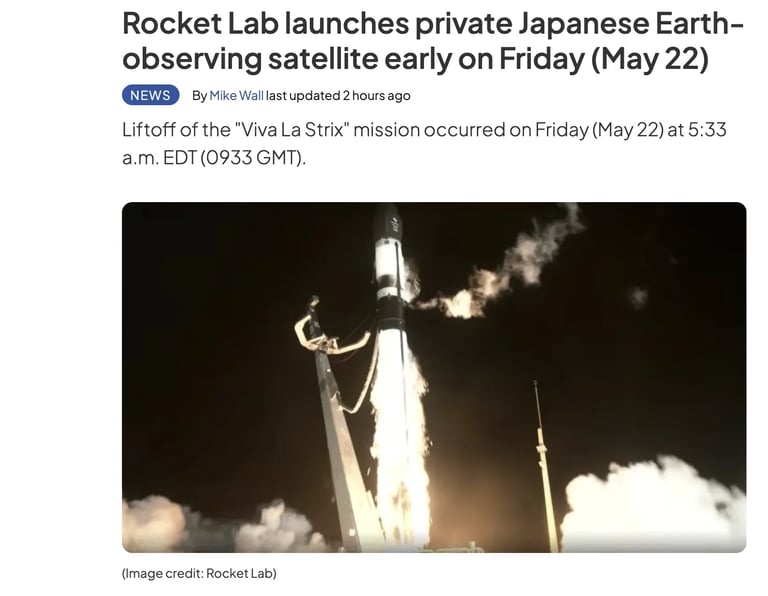

Synspective’s Strix radar-imaging satellite was deployed into low Earth orbit at an altitude of about 572 kilometers, expanding Japan’s radar constellation.
The mission used Rocket Lab’s Electron rocket, a 59-foot-tall vehicle with a history of 77 prior liftoffs, designed for dedicated rides to orbit for small satellites.
Rocket Lab’s Electron program has achieved 88 launches since 2017, and the company also operates the HASTE suborbital derivative for hypersonic testing.
Strix satellites are part of a broader SAR constellation capable of imaging through clouds and in darkness to aid planning, construction, and emergency response.
Strix is intended to join the same 572-kilometer low Earth orbit to support Synspective’s Earth observation network.
The Strix mission is framed within Synspective’s broader goals of urban development support and disaster management, highlighting a strategic collaboration with Rocket Lab.
This marks the ninth dedicated launch for Synspective by Rocket Lab since 2020, with a contract for 18 more Electron missions to complete the constellation by 2030.
Viva La Strix represents the ninth mission in Synspective’s partnership with Rocket Lab, continuing expansion of the satellite network.
Rocket Lab has been Synspective’s sole launch provider since 2020, with 18 additional missions booked to finish the constellation by 2030.
The collaboration underscores a long-term partnership that uses Electron to deploy Japan’s targeted radar-imaging network.
Synspective is building a SAR satellite constellation to deliver data for urban planning, construction, infrastructure monitoring, and disaster response in Japan.
As a Tokyo-based company, Synspective aims to provide precise spatial data for urban planning, infrastructure monitoring, and disaster coordination, with radar capable of operating under cloudy or night conditions.
Summary based on 3 sources
Get a daily email with more Science stories
Sources


UA.NEWS • May 22, 2026
Rocket Lab launched an Earth observation satellite for the Japanese company Synspective