Pulsars Reveal Galactic Mass: New Technique Weighs Nearby Galaxies with Unprecedented Precision
May 29, 2026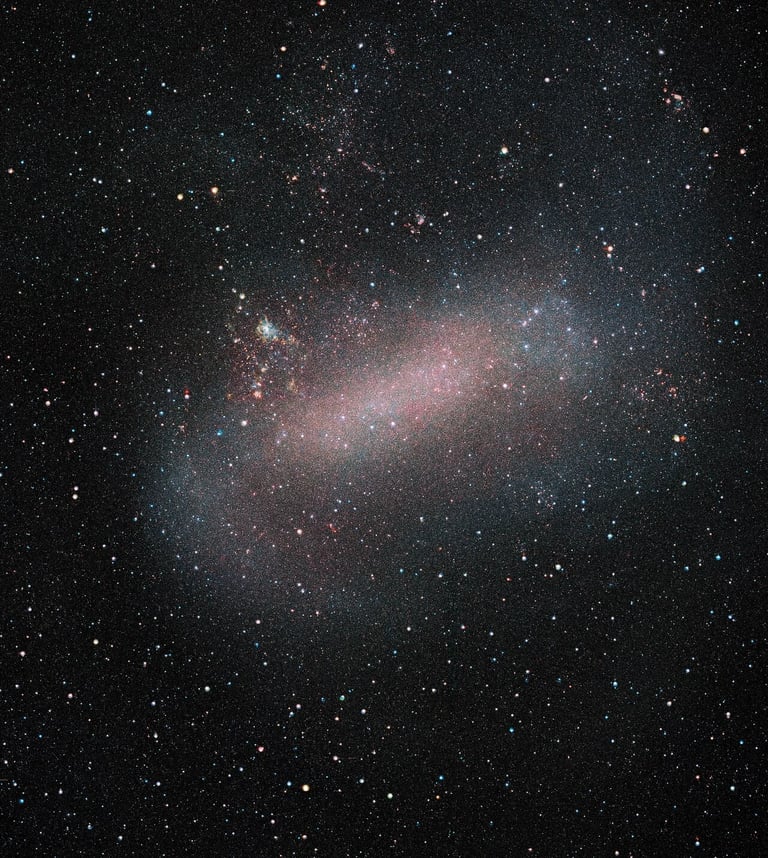

A team used timing data from 54 millisecond pulsars across the Milky Way to detect tiny accelerations in our galactic neighborhood caused by the Large Magellanic Cloud and the Sagittarius Dwarf Spheroidal Galaxy.
This pulsar-timing method provides a more direct, less history-dependent measure of galactic mass than traditional stellar-kinematics, which can be confounded by past interactions and non-steady states.
Researchers at the University of Alabama in Huntsville demonstrate a new technique to weigh nearby galaxies by using pulsars as ultra-precise gravitational probes.
With more pulsars and higher timing precision, the approach could map dark matter sub-halos within the Milky Way, shedding light on dark matter’s nature.
Pulsars are highly regular rotating neutron stars that emit beams of radio waves; timing changes in their pulses reveal gravitational disturbances with microsecond precision.
Accelerations, unlike velocities, reflect ongoing forces and dissipate when the perturbing influence ends, enabling a cleaner read on current gravitational effects.
Using pulsar timing and computer simulations, the team estimated the LMC’s mass at about 41 billion solar masses and the Sagittarius Dwarf Galaxy’s mass at about 350 million solar masses, including their dark matter.
Summary based on 1 source
Get a daily email with more Space News stories
Source
Universe Today
We Can Now Weigh Galaxies Using Dead Stars As Scales