Ultrastable Lasers to Revolutionize Lunar Navigation for Artemis-Era Missions
May 30, 2026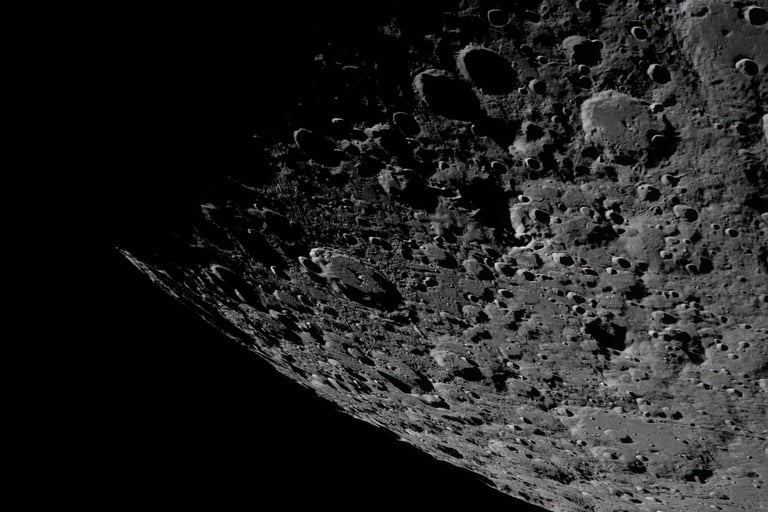

A team led by physicist Jun Ye is exploring ultrastable lasers housed in silicon optical cavities as a navigation and timing infrastructure for Artemis-era lunar missions.
Researchers from the National Institute of Standards and Technology propose placing ultrastable lasers in permanently shadowed lunar craters near the Moon’s south pole to create a GPS-like navigation system for future Artemis missions and lunar spacecraft.
The proposed sites are the Moon’s polar permanently shadowed craters, chosen for their extreme cold, deep vacuum, and lack of direct sunlight to minimize thermal and vibrational noise.
The timeline envisions initial optical clock and navigation capabilities on the Moon within three to five years after in-space testing, contingent on successful demonstrations on Earth and in space.
The harsh, ultra-cold, high-vacuum, and vibration-suppressed crater environment could allow silicon optical cavities to operate with minimal thermal expansion, reducing the need for Earth-based tracking for navigation.
The stabilized laser would function as a GPS-like signal for guiding lunar landings and spacecraft, forming the backbone of an extraterrestrial optical atomic clock and a high-precision timekeeping network.
The concept relies on an optical cavity that stabilizes laser light to a precise frequency, enabling accurate distance measurements and timing references for a network of lunar satellites and communications links.
Such a lunar optical timing backbone could serve as the master reference for laser navigation and potentially connect with satellite-based atomic clocks to form the foundation of an optical clock on the Moon’s surface.
the installation would be Earth-assembled, transported to the Moon, unfolded by radiation panels, and lowered into a crater by a robotic rover guided by astronauts or remotely controlled systems.
The study builds on prior work about using ultrastable lasers in the Moon’s permanently shadowed regions and suggests that the Moon’s natural crater conditions may reduce the need for cooling and vibration mitigation performed on Earth.
The silicon cavity and its vibration-minimizing mount are designed to withstand Moonquakes and seismic noise, aiming for laser frequency stability mainly limited by thermal Brownian noise of the mirrors.
A network of such lasers could measure distances on the Moon with high precision and potentially serve as a gravitational-wave detector, with early testing in low-Earth orbit planned before lunar deployment.
Summary based on 2 sources
Get a daily email with more Science stories
Sources
Space • May 19, 2026
Lasers in moon craters could create a lunar GPS system
Universe Today
Lasers at the Lunar Poles Could Help Astronauts Navigate