White Paper Advocates for Hubble's Role in Exoplanet Study Through 2030s
June 5, 2026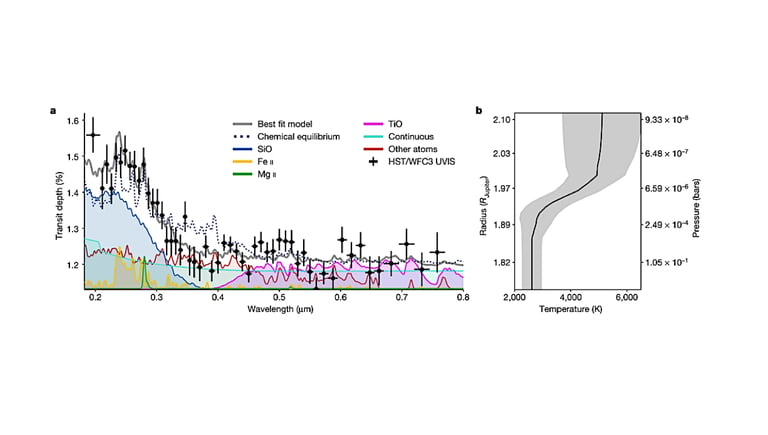

The document responds to STScI’s call for white papers to map Hubble’s science role into the 2030s, signaling strategic planning for continuing Hubble-era science beyond its primary mission period.
A new white paper argues that the Hubble Space Telescope remains essential for exoplanet atmospheric characterization in the 2030s because its access to short-wavelength observations cannot be fully replaced by JWST.
Three core science goals rely on Hubble’s short-wavelength capabilities: measuring aerosol scattering slopes to reveal cloud and haze properties, characterizing metal absorption features in ultra-hot Jupiters, and studying stellar activity through Transit Light Source effect decontamination and flare monitoring.
The paper highlights recent theoretical advances and observing strategies using WFC3-UVIS/G280 that enable science cases unique to Hubble, especially for probing the hydrostatic lower atmospheres of exoplanets.
It stresses useful synergies between HST and JWST, showing how coordinated observations can jointly advance atmospheric characterization of exoplanets.
Summary based on 1 source
Get a daily email with more Space News stories
Source
Astrobiology • Jun 5, 2026
Characterizing Transiting Exoplanet Atmospheres in the 2030s with the Hubble Space Telescope