James Webb Telescope Unveils Most Detailed Cosmic Web Map, Tracing Early Universe Galaxies
June 5, 2026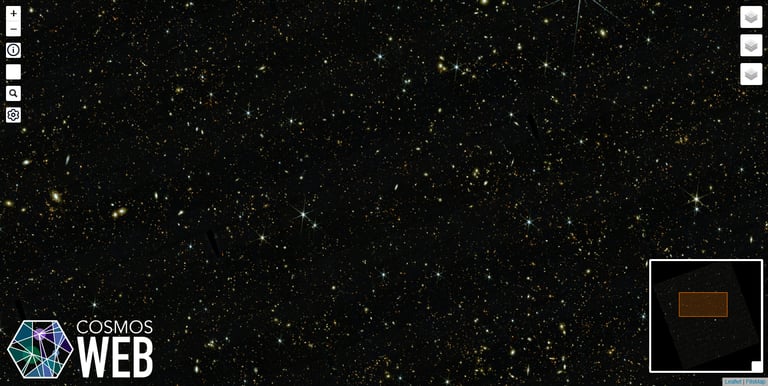

The map showcases JWST’s ability to detect faint galaxies and place them precisely in cosmic time, delivering a more detailed view of the early universe’s large-scale structure than previous Hubble-era maps.
The COSMOS-Web map was built using JWST’s NIRCam and MIRI instruments, achieving unprecedented depth and resolution to reveal structures hidden in earlier observations.
NASA’s James Webb Space Telescope has produced the most detailed map of the cosmic web to date, tracing galaxies and filaments back to roughly one billion years after the Big Bang.
The study was led by Hossein Hatamnia of UC Riverside, with Bahram Mobasher as advisor, and involved international collaborators from LAM, DAWN, MINGAL, IPAC, STScI, and JPL, with results published in The Astrophysical Journal on May 6.
COSMOS-Web is the largest Cycle 1 General Observer program, comprising 152 wide-field observations totaling 255 hours, designed to trace galaxy evolution from the Epoch of Reionization to today and to probe dark matter’s role.
The release provides public access to COSMOS-Web data, including the large-scale structure maps, a catalog of 164,000 galaxies, and a video illustrating the cosmic web’s evolution over billions of years.
Summary based on 1 source
Get a daily email with more Space News stories
Source
Universe Today
The Cosmic Web Like You've Never Seen it Before