Parker Solar Probe Unveils Sun's Mysterious Heat with Record-Breaking Corona Entry
June 6, 2026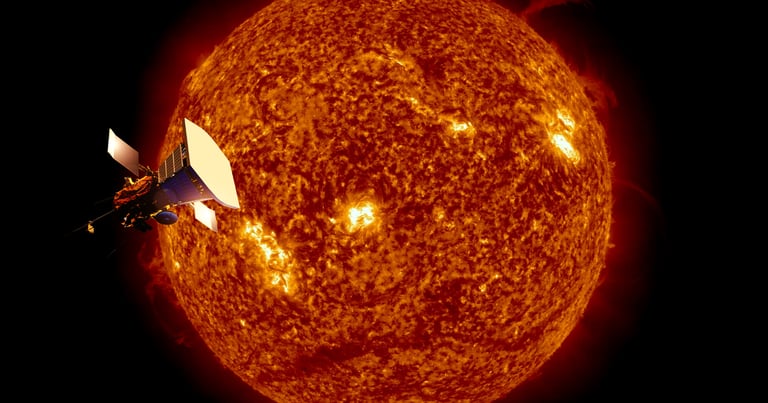

In December 2024, Parker achieved a record-breakingly close approach to the Sun, skimming 6.1 million kilometers above the surface at about 692,000 kilometers per hour, and survived to collect data.
The Parker Solar Probe has repeatedly entered the Sun’s corona—the outer atmosphere where temperatures exceed one million degrees Celsius—while the visible surface remains around 5,500 degrees, providing unprecedented in-situ measurements.
Over successive orbits, Parker has gradually extended its time inside the corona, aided by gravity assists, including seven Venus flybys, with the latest boost enabling closer solar incursions.
A key finding is the presence of switchbacks—abrupt reversals in the Sun’s magnetic field—in the young solar wind near the Sun; these may contribute to heating and wind acceleration but appear confined to the solar wind, not the corona itself, per a July 2024 study.
Parker’s measurements confirm that the fast solar wind is partly powered by switchbacks, while the slower wind appears to have two distinct types with different likely origins, leaving the coronal heating mechanism unresolved.
The mission records plasma density, temperature, magnetic field, and flow using a carbon-composite heat shield that shields instruments during close passes through the near-Sun environment.
The central puzzle remains: why the corona is so hot, given that heat should flow from hotter regions to cooler ones, a question traced back to early spectral observations in the 1940s.
Two leading hypotheses—wave heating from magnetic waves and small-scale magnetic reconnection events (nanoflares)—have competed for decades, with no definitive dominant mechanism yet established.
Analyses show that data from repeated perihelion passes during the Sun’s active 11-year cycle will help distinguish between wave heating and reconnection, rather than providing a final, one-size-fits-all answer.
The current status notes Parker is not setting record-fast loops every time but continues to yield valuable data, with a future phase after 2026 under NASA review to test competing explanations.
Overall, Parker delivers direct, in-situ observations inside the near-Sun corona, enabling study of plasma properties and magnetic structures that drive solar wind and coronal heating.
Summary based on 1 source