AstroPix to Revolutionize Gamma-Ray Astronomy with 2027 Orbital Demo on Fly Foundational Robots
June 13, 2026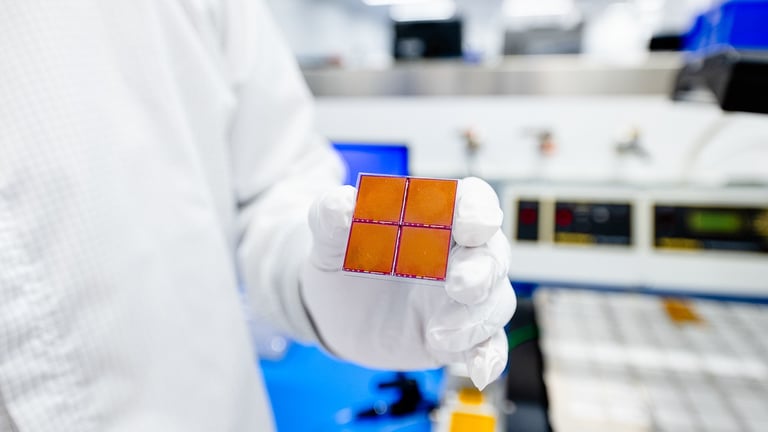

The AstroPix project aims to advance gamma-ray astronomy by filling sensitivity gaps to study gamma-ray bursts and jet-powered galaxies, contributing to a deeper understanding of extreme cosmic processes.
The mission includes an orbital demonstration to test AstroPix performance in a near-space to orbital environment, potentially expanding gamma-ray observations of cosmic sources.
AstroPix hardware is slated for delivery in September and will be integrated into the Fly Foundational Robots payload, supported by multiple NASA centers and collaborators, including Goddard Space Flight Center, ISAM, Astro Digital, Rocket Lab Robotics, and NASA Flight Opportunities.
The hardware will be integrated into an Orbital Replacement Unit with power, data collection, and transmission capabilities for the demonstration.
The article’s author, James Hydzik, provides context about the publication and contributing organizations.
Each AstroPix chip contains four silicon pixel detectors with 1,225 pixels per detector, functioning similarly to cell phone camera sensors.
Quotes from AstroPix team member Dan Violette and senior technical lead Bo Naasz highlight testing goals and the integration approach.
Funding and support come from NASA’s Space Technology Mission Directorate and the Nancy Grace Roman Technology Fellowship, with involvement from NASA’s Astrophysics Division.
NASA is developing AstroPix as a new gamma-ray sensor technology for a robotic arm demonstration on the Fly Foundational Robots mission, planned to launch in late 2027.
The gamma-ray sensor AstroPix is introduced for a 2027 Fly Foundational Robots mission as a robotic arm demonstration in space.
The mission aims to validate robotic payload changeout in space, enabling future upgrades to satellites and instruments at a fraction of the cost of full missions, as part of NASA’s ISAM portfolio and partnerships with Rocket Lab Robotics and Astro Digital.
The program highlights robotic payload changeouts in orbit to lower costs for upgrades, aligning with ISAM goals and industry partnerships.
Summary based on 2 sources
Get a daily email with more Space News stories
Sources
NASA Science • Jun 11, 2026
NASA Robotic Tech Demo Will Advance Prototype Gamma-Ray Detectors - NASA Science
Orbital Today • Jun 12, 2026
NASA’s New Gamma-Ray Detector To Be Trialed In 2027