Giant Gas Planets Spin Faster Than Brown Dwarfs, Offering Clues to Formation History
June 13, 2026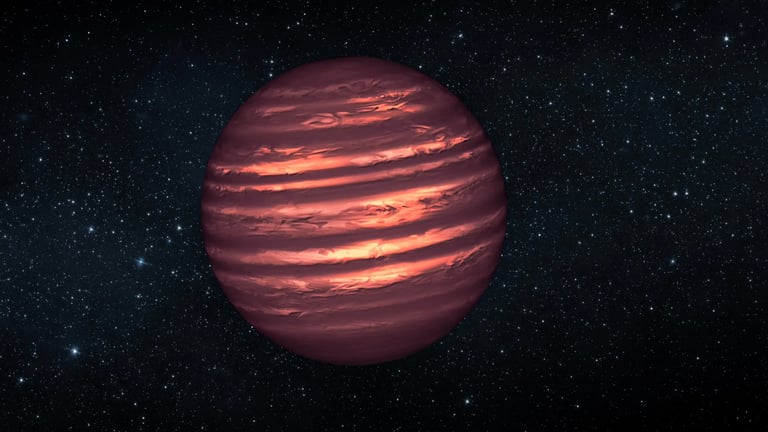

After accounting for mass, size, and age, giant gas planets tend to spin faster than more massive brown dwarfs, suggesting a link between mass, spin, and formation history across planetary systems.
Using the KPIC instrument, researchers observe how atmospheric features broaden a planet’s spectrum as it rotates, yielding spin rates for objects orbiting far from their stars.
Lead author Dino Hsu notes that spin acts as a fossil record of formation, and KPIC’s measurements open a new window for studying exoplanet rotation that was previously inaccessible.
Future work will compare spins of closer-in planets with those in our Solar System to assess whether Earth’s and Jupiter’s spins reflect common formation pathways.
Plans to extend studies to free-floating planets and their atmospheres, leveraging upcoming improvements like the HISPEC instrument (operational from 2027) to measure spins of smaller and more distant worlds.
Overall, the research advances understanding of how angular momentum is distributed in planetary systems and how spin relates to formation history across a broad range of objects.
At Keck Observatory, rotation rates were measured for 32 distant giant planets and brown dwarf companions, expanding the dataset to include 43 stellar/substellar companions and 54 free-floating brown dwarfs and planetary-mass objects.
Findings imply that magnetic fields and angular momentum distributions during formation influence final spin, linking planetary spin to formation processes and system architecture.
In the HR 8799 system, a ~7 Jupiter-mass planet spins about six times faster than a ~24 Jupiter-mass brown dwarf companion, possibly due to stronger early magnetic interactions affecting the larger body.
Summary based on 1 source
Get a daily email with more Science stories
Source
ScienceDaily • Jun 13, 2026
Alien planet spins revealed a hidden clue to how worlds form