Satellite Surge Threatens Night Sky, Astronomical Research at Risk as SpaceX Plans Massive Expansion
June 13, 2026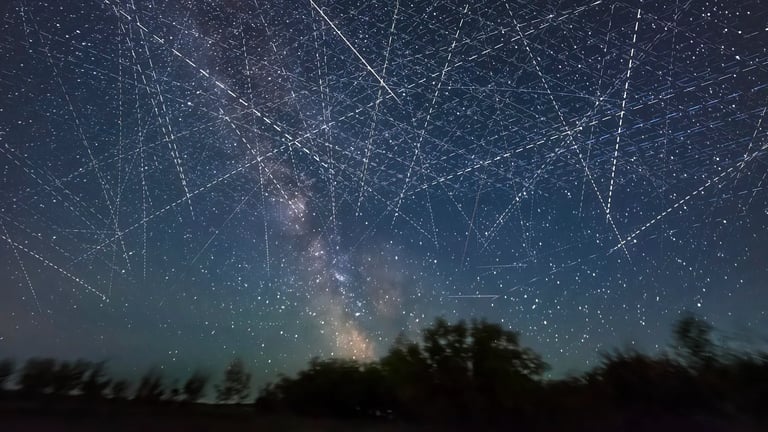


New research shows that satellite activity could brighten the night sky by more than 10% above natural levels, reducing data quality for both ground-based and radio astronomy observatories and hindering astronomical observations.
SpaceX has filed with the FCC to potentially launch up to a million satellites to support orbital AI data centers and future space infrastructure, signaling a shift from pure communications to comprehensive orbital infrastructure.
This discussion builds on longstanding concerns since 2019 about Starlink’s impact on telescope imagery and the broader competition between satellite-derived infrastructure and traditional astronomical research.
The issue underscores a shift in how the night sky is perceived and studied, with potential global and long-term effects on astronomy, navigation, wildlife migration, and other science dependent on dark skies.
Leading astronomers and institutions warn that extremely bright satellite beams and large constellations could permanently scar the night sky, potentially reaching brightness levels four times that of the full Moon in extreme concepts, with global implications beyond local light pollution.
SpaceX’s Starlink megaconstellation already operates over 10,000 satellites, accounting for about two-thirds of all active satellites in orbit, with plans to expand to roughly 34,400 satellites.
Summary based on 1 source
Get a daily email with more Tech stories
Source

Forbes • Jun 13, 2026
Why A $1.77 Trillion SpaceX IPO Could ‘Permanently Scar’ The Night Sky