Mimas: The Ancient Moon with a Hidden Young Ocean Beneath Its Icy Surface
August 16, 2026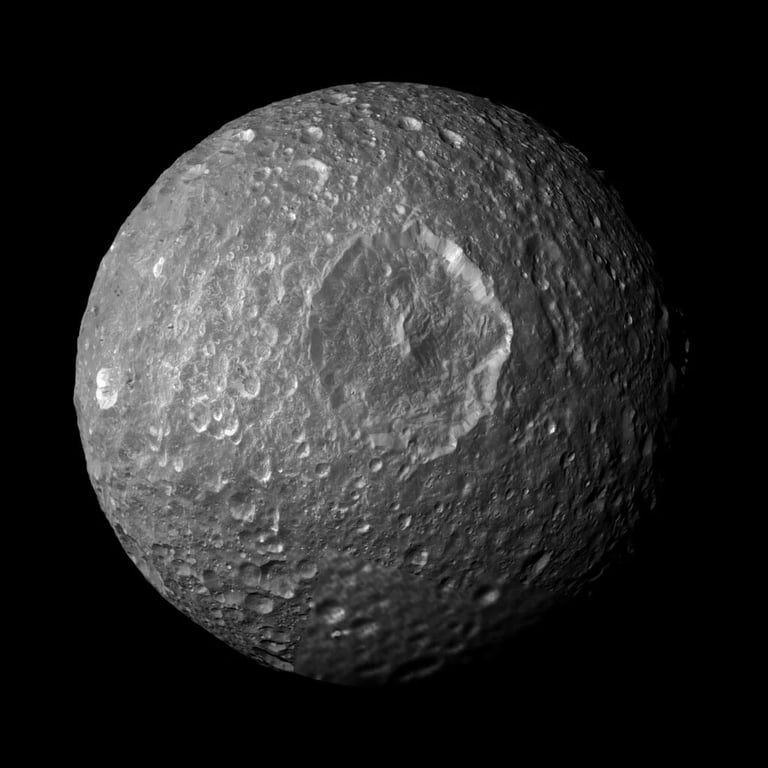

The youth of Mimas’ ocean helps explain why the surface looks ancient and largely inactive, with little evidence of the usual ocean-world activity, despite an internal liquid layer.
Unlike Enceladus or Europa, Mimas shows minimal recent geological activity on its surface even though it harbors a global subsurface ocean.
These findings have broad implications for habitability prospects and underscore the role of orbital dynamics—such as eccentricity and tidal heating—in evaluating hidden oceans on icy moons.
Evidence is indirect, relying on geophysical modeling of motion and gravity rather than direct measurements of water properties; future missions could refine depth, salinity, and chemistry.
The inferred ocean is very young, likely formed within the last 25 million years, with some models placing it between roughly 5 and 15 million years.
The result expands how scientists define ocean worlds, showing that a heavily cratered, seemingly inactive moon can still host a young subsurface ocean.
Cassini-era data on Mimas’ rotation, libration, and periapsis drift point to a water layer as the best explanation for the observed dynamics.
Mimas, a small, heavily cratered Saturnian moon, hosts a global ocean beneath about 20 to 30 kilometers of ice, a discovery crystallized through 2024 analyses rather than direct observation.
Summary based on 1 source