NASA Backs SPARK Project to Explore Titan's Caves with Autonomous Flying Vehicles
August 16, 2026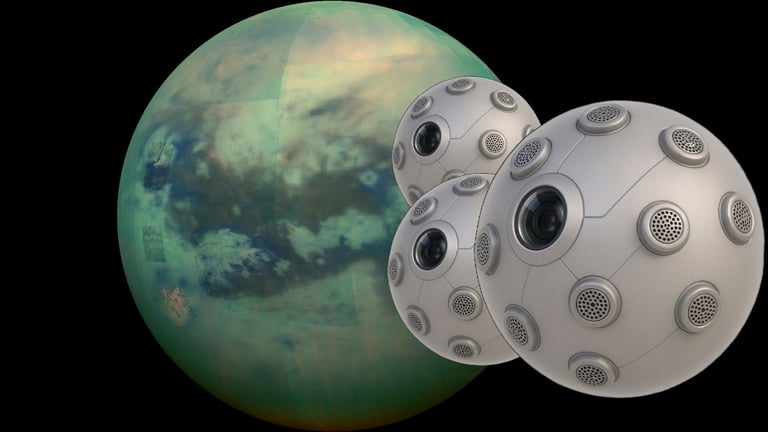

NASA is funding a NIAC feasibility project to develop SPARK, a swarm of small, lighter-than-air aerobots using solid-state ion propulsion to explore Titan’s karst terrain and subsurface caves.
SPARK envisions three-foot-wide, lighter-than-air robots deployed from a larger lander to fly through Titan’s subsurface channels and sinkholes, powered by electrohydrodynamic propulsion that ionizes air for thrust without combustion.
The propulsion system eliminates moving parts and heat sources, reducing heat stress and the need for heaters in Titan’s extreme cold.
The effort is in a nine-month feasibility study, with a potential second phase up to two years to develop a prototype if feasibility is demonstrated.
Lead researcher Daniel Drew from the University of Hawai‘i at Mānoa notes potential alignment with Dragonfly but cautions about timelines and readiness for Titan exploration.
Phase 1 will run rapid design experiments, perform subsystems trade studies (power, cooling, etc.), and conduct thermal modeling to prepare a comprehensive public report.
A major advantage is zero heat stress due to the lack of moving parts, avoiding heating requirements for freezing in Titan’s cold environment.
Titan’s vast methane-ethane seas and extensive hydrocarbon landscapes make it an attractive target for astrobiology and exploration, a point highlighted since its discovery by a Dutch scientist in 1655.
On Titan, ion thrusters are expected to deliver over 100 times lower power consumption and better performance than Earth-based rotors under Titan conditions.
SPARK’s advantages include reduced downwash over hydrocarbon layers and operation in near-cryogenic conditions, but energy efficiency remains a key limitation for broader applications.
Lead investigator Drew’s background includes microfabricated ion-propelled devices and early ionocraft work, building on NSF-supported research and hobbyist high-voltage propulsion experiments.
Titan’s thick atmosphere and surface hydrocarbons, plus potential subsurface karst networks, present exploration challenges for traditional rovers and landers.
Summary based on 3 sources