First Stellar-Mass Black Hole Detected in Omega Centauri, Validating Astrometric Methods
August 20, 2026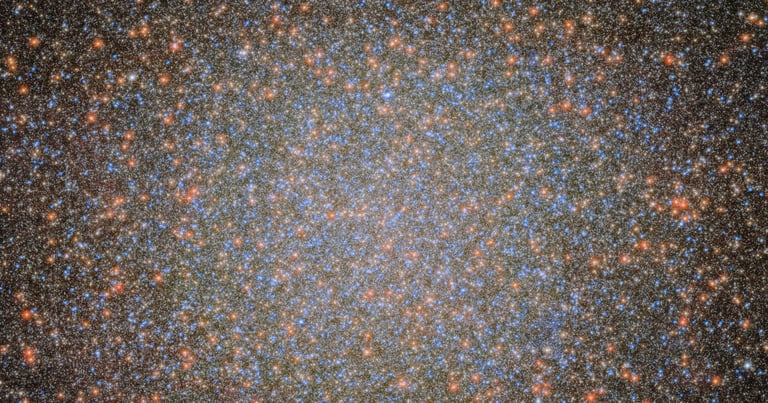

Future observations with Webb, Hubble, and next-generation astrometry could refine the mass and orbital period estimates for Omega Centauri’s hidden black holes and help identify additional unseen companions.
The companion is estimated at about 4.46 solar masses, a range that strongly favors a black hole over a neutron star given known mass limits.
While this finding doesn’t confirm the cluster’s proposed central intermediate-mass black hole, it validates the methods used to probe hidden remnants that models have long predicted.
A University of Utah-led team announced the first directly detected stellar-mass black hole in Omega Centauri, identified by tracking a star in a roughly 94-year orbit around an unseen companion.
The system, named oMEGACat BH-2, likely formed through dynamical interactions in the cluster and currently exists as a loosely bound, soft binary that could be disrupted by future encounters within hundreds of millions of years.
The orbital period is constrained to about 94 years, with data from a close periastron passage providing curvature and acceleration measurements essential to determining the mass.
The black hole was not observed directly; its presence is inferred from precise astrometric measurements of the visible star’s motion using Hubble data from 2002–2023 and JWST data from 2024–2025.
The discovery demonstrates the viability of astrometric methods to reveal hidden black-hole populations in crowded clusters, even when black holes themselves emit no light.
Models suggest Omega Centauri could host many stellar-mass black holes—potentially around 10,000—most of which are quiescent and detectable mainly through dynamical approaches like astrometry.
Summary based on 1 source