Mars' Southern Mantle Mystery: Study Reveals Unexpected Heat Anomaly, Impacting Habitability and Crust Formation
August 26, 2026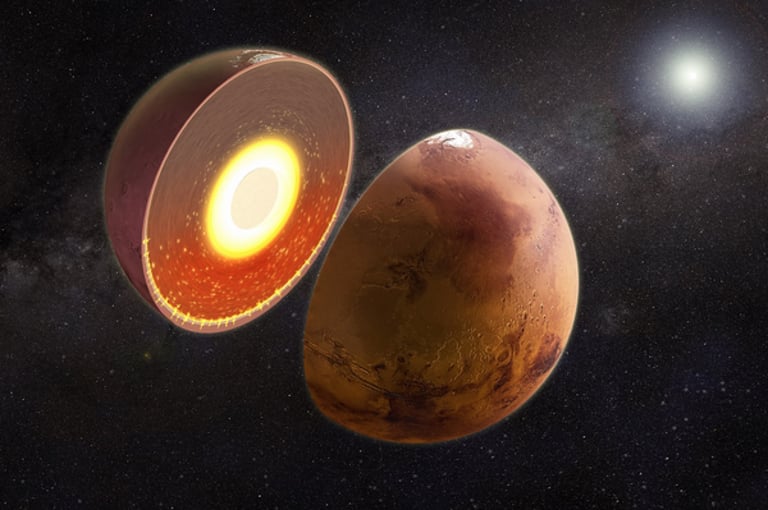


A new Nature study led by a Caltech alumnus uses 16 years of Mars orbiter radio tracking data and tidal tomography to map Mars’ interior, revealing a deep underground thermal anomaly that makes the southern mantle 200–400°C (roughly 400–750°F) hotter than the north.
The warmer southern mantle could help explain magnetic anomalies in the south and faster seismic dissipation observed by NASA’s InSight mission, signaling a hemispheric mantle temperature contrast.
The research is a collaborative effort involving Brown University, the University of Arizona, NASA Goddard, Academia Sinica, and other international institutions, with NASA funding backing the work.
Findings have implications for Mars’ hydrological history, basin formation, and potential past habitability, and they may guide future mission design.
Published in Nature on August 27, 2026, the study uses a three-dimensional interior model based on gravity variations rather than assuming spherical symmetry.
The team suggests possible causes for the southern warmth, including ongoing mantle convection or insulation under the southern highlands, and notes ancient impacts could also play a role in crustal structure.
They propose that a gradual, year-long tidal deformation could account for a north-south temperature difference of a few hundred degrees, rather than indicating a globally molten state.
The origin of Mars’ crustal dichotomy remains debated; Berne and colleagues argue these processes may be linked, with an initial northern impact excavating the basin while heat remained trapped under the southern crust.
The findings imply the dichotomy may have shaped early habitability and possible ancient life sites, though direct measurements are needed to confirm the thermal anomaly hypothesis.
The anomaly could help explain the long-standing dichotomy between the northern lowlands and southern highlands by pointing to interior mantle processes influencing surface crust.
Interpretation indicates the mantle’s rigidity differs by more than 20 percent between hemispheres, with a stiffer north and a softer, warmer south, requiring a non-uniform interior model.
Tidal tomography, previously used on Earth and the Moon, is applied to Mars for the first time, offering a noninvasive method to study planetary interiors and guiding future missions.
Summary based on 3 sources
Get a daily email with more Tech stories
Sources

California Institute of Technology • Aug 26, 2026
Thermal Anomaly Discovered Below Mars's South Pole
Scientific American • Aug 26, 2026
Mars may be two-faced to its core
404 Media • Aug 26, 2026
Scientists Discover Vast Underground 'Anomaly' on Mars