First Observational Proof of Supermassive Black Hole Ejection Captured by Space Telescopes
September 2, 2026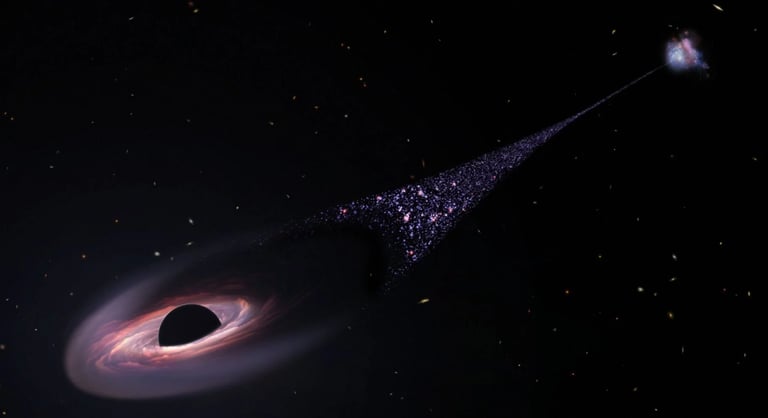

General Relativity predicts that 5–10% of galactic mergers eject supermassive black holes, and this study provides the first observational account of such an ejection in action, shedding light on gravitational waves from massive black-hole mergers and galaxy evolution.
A UCSB-led team using Hubble and James Webb Space Telescopes traced RBH-1 back to its source and concluded the ejection resulted from a violent merger between two black holes during a past galactic merger.
Simulations of hundreds of thousands of black-hole pairs matched RBH-1’s recoil speed, indicating the progenitors had similar masses with one up to six times the other and highly misaligned, rapid spins; the heavier black hole spun at roughly 70–75% of the maximum, and was tilted.
A galaxy about 7.5 billion light-years away hosts a 200,000-light-year-long stellar jet-like feature (RBH-1) extending from the galaxy; initially thought to be an imaging artifact, it was confirmed as young blue stars linked to the galaxy, signaling a runaway supermassive black hole ejected at speeds near 1,000 km/s.
The merger likely occurred roughly 70 million years ago during a galactic merger between GX and another galaxy, with the post-merger SMBH ejected due to asymmetric gravitational-wave emission during the merger.
The findings point to future progress with next-generation observatories like LISA for detecting low-frequency gravitational waves from such massive mergers, complemented by JWST and future telescopes’ detailed imaging and spectroscopy.
Summary based on 1 source
Get a daily email with more Space News stories
Source
Universe Today • Sep 2, 2026
Physicists Determine Cause of "Runaway" Supermassive Black Hole