Potential Dark Matter Signal Detected by LZ, Awaits Further Verification
September 2, 2026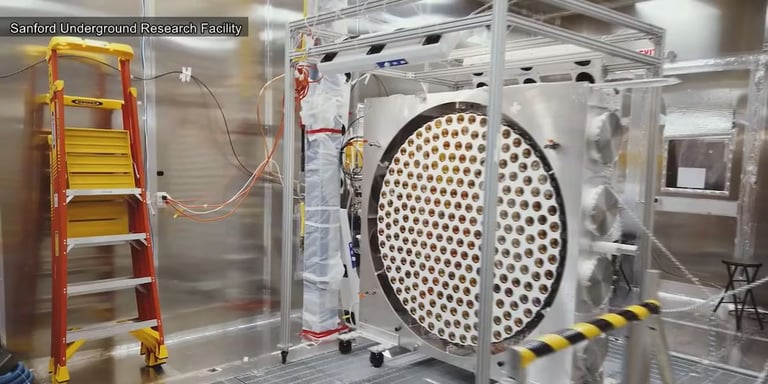

Underground LZ experiment scientists report a striking signal that could be dark matter, though it has not yet achieved the statistical significance needed for a discovery.
An expanded analysis of 220 live days of data, spanning March 2023 to April 2024, extends the search to higher-energy nuclear recoils and explores broader WIMP interaction models.
The result appears in a preprint and was presented at the 2026 TeV Particle Astrophysics Conference in Japan, with researchers urging cautious interpretation and openness to input from the scientific community.
Closing reader note invites feedback and points to related Nature Briefing sections and careers resources.
Program context includes presentation by Roland Pease, with a listed production and editorial team and links to programme pages and future episodes.
Presenter and production details note Roland Pease as host, with producers and editors named, reflecting the team behind the segment.
A secondary science discussion features microbiologist Erika Santoro on probiotic treatments for coral reefs and their potential benefits for Red Sea ecosystems.
Santoro describes probiotic treatments tested on Red Sea reefs and their potential to support coral health.
The Royal Society Trivedi Science Book Prize shortlist highlights Fred Pearce’s 'Despite it All: A Handbook for Climate Hopefuls' as a focus on progress in protecting the planet.
Core team includes Dr. Sam Eriksen of the University of Bristol and Prof. Rick Gaitskell as LZ spokesperson, with UKRI/STFC funding supporting the Bristol LZ group.
Imperial College London researchers contributed to analysis and waveform techniques, underscoring on-site involvement and data interpretation.
A broader health science note discusses growing interest and funding for long COVID and post-acute infection syndromes, with hopes for transformative advances.
Summary based on 90 sources
Get a daily email with more Science stories
Sources
Mashable • Sep 3, 2026
Dark matter discovery? A simple Q&A on what it really means

Interesting Engineering • Sep 1, 2026
Dark matter finally found? Detector spots rare particle event with no source
Economic Times • Sep 2, 2026
'Dark Matter' finally spotted? Scientists find mysterious particle signal in South Dakota's LZ detector; c