SKA-Low's New Pattern Solves Sensitivity Drop, Enhances Sky Coverage for Alien Life Search
September 28, 2026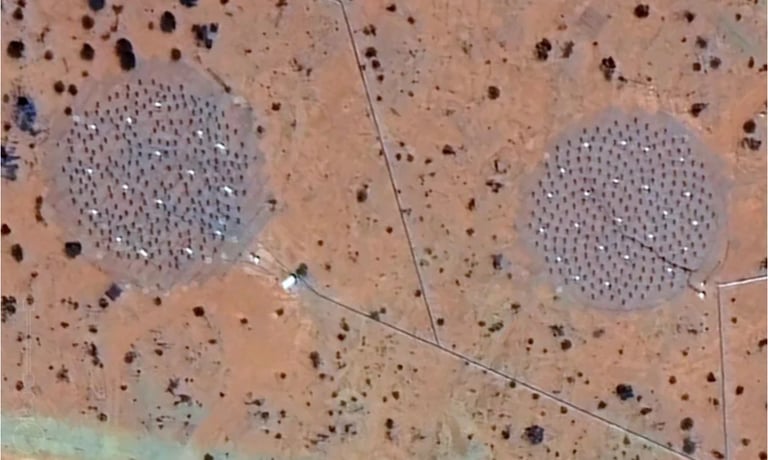

The Perturbed Vogel pattern preserves the benefits of the spiral layout while mitigating a 125 MHz sensitivity drop, yielding more uniform sky coverage as SKA-Low advances toward deployment.
Initial test layouts used a pseudo-random arrangement to suppress grating lobes, but some antennas ended up too close, causing mutual coupling and data artifacts at the lower frequencies near 55 MHz and 78 MHz.
A 2.4-meter spacing created destructive interference for overhead signals, revealing a blind spot in the Vogel spiral’s regular spacing.
The article frames ongoing challenges in radio astronomy and positions SKA as a major future instrument for astronomical observations, including the search for alien life.
To address these issues, researchers introduced a Perturbed Vogel pattern, adding small perturbations to antenna positions to prevent close spacing while avoiding repeating, highly regular gaps.
Additional references provide technical details and verification studies related to SKA-Low and Vogel layouts.
The Square Kilometre Array Low (SKA-Low) project in Australia employs 512 stations with 256 SKALA4.1 antennas per station, totaling over 131,000 antennas across 75 square kilometers.
A subsequent design, AAVS3, used a Vogel spiral modeled after sunflower seed patterns to balance even spacing with avoidance of linear regularities.
Simulations and tests identified a critical 125 MHz sensitivity drop when antennas point straight up due to interference from the 2.4-meter inter-antenna spacing.
Summary based on 1 source
Get a daily email with more Space News stories
Source
Universe Today • Sep 28, 2026
Why the World’s Biggest Radio Telescope Had to Tweak Nature’s Perfect Sunflower Spiral