Black Hole Jets Disrupt Galaxy Growth by Heating and Ionizing Circumgalactic Medium
September 30, 2026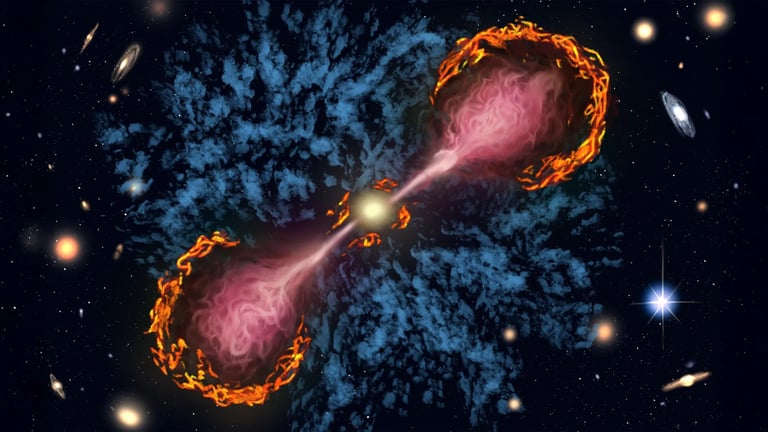

Jets from supermassive black holes heat, stir, and disrupt the circumgalactic medium, cutting off the cold gas supply that fuels star formation and helping push galaxies toward quiescence.
The findings align with theoretical expectations that active galactic nuclei regulate host galaxies by heating or dispersing gas that would otherwise feed star formation.
By disrupting the CGM, black hole jets can suppress star formation and effectively slow or halt growth in their host galaxies.
The article is a research highlight published on October 1, 2026, with a DOI linking to the related Nature article for further details.
The study appears in the Astrophysical Journal Letters and is led by Sanchayeeta Borthakur of Arizona State University and Namrata Roy of the Raman Research Institute.
Publication is in the Astrophysical Journal Letters.
Related topics include Nature Portfolio pieces on Europe’s space-independence push amid geopolitical rifts and simulations showing the existence of overmassive black holes.
The brightest ionized regions occur where jets first meet the CGM and at the CGM’s outer edge, showing jets heat and ionize gas at preferred locations near a galaxy’s outskirts.
Two prominent ionized hydrogen regions are noted: at the jet-CGM impact point and at the outer edge where energy is deposited.
The team combined DESI optical survey data with LoTSS radio jet measurements to detect H-alpha emission from ionized gas along jet paths across hundreds of galaxies.
Observations reveal ionized gas glowing along jet axes, marking where jets energize the surrounding medium.
The work underscores the value of merging large optical and radio surveys to uncover faint, directional signals in the CGM and to test jet-galaxy interaction models.
Summary based on 3 sources