World's Largest Cherenkov Telescopes Unveiled in La Palma to Explore Cosmic Mysteries
October 16, 2026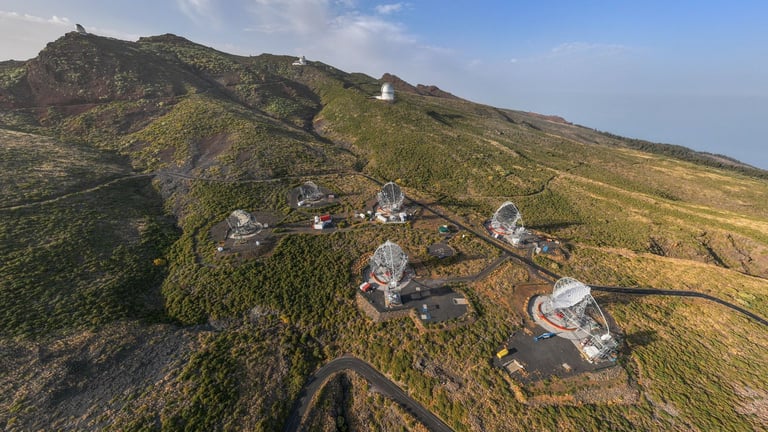

Four large Cherenkov telescopes, each 23 meters in diameter with 198 hexagonal mirror facets, were officially inaugurated on La Palma at Roque de los Muchachos to detect high-energy gamma radiation from distant galaxies.
These telescopes observe Cherenkov light produced when gamma rays interact with Earth's atmosphere, using multiple viewpoints to triangulate the energy and origin of the rays.
Together they form part of the Cherenkov Telescope Array Observatory (CTAO), capable of rapid, wide-field tracking with ultrafast cameras to observe transient space events.
Key project leaders include Hidetoshi Kubo and Masahiro Teshima, who highlighted the potential to uncover dark matter.
The project targets extreme cosmic environments—supermassive black holes, neutron stars, the origins of cosmic radiation, and dark matter—reflecting more than 15 years of international collaboration.
The telescopes will study objects up to about 12 billion light-years away, offering insights into the early universe.
The concept traces back to a 1967 satellite false alarm that detected a gamma-ray burst from space, which spurred the idea of ground-based Cherenkov observations.
CTAO operates as a multinational observatory with sites in La Palma, Spain and Paranal, Chile, functioning as a single system to study cosmic phenomena.
The array’s method enables rapid responses to transient events, with the ability to turn 180 degrees in 20 seconds.
A Japan-led team completed the four giant Cherenkov telescopes on La Palma as part of the CTAO project.
The project involves 25 countries and about 30 Japanese institutions, underscoring its broad international collaboration.
CTAO plans to expand to 64 telescopes by 2030 and establish a second site in Chile’s Atacama Desert to achieve full-sky coverage and enhance sensitivity.
Summary based on 3 sources
Get a daily email with more Space News stories
Sources
Japan Wire by Kyodo News • Oct 16, 2026
Japan-led team completes telescopes in Spain to study space mysteries