Mystery of Red Dots: Are They Black Holes or New 'Black Hole Stars'? Scientific Debate Heats Up
October 24, 2026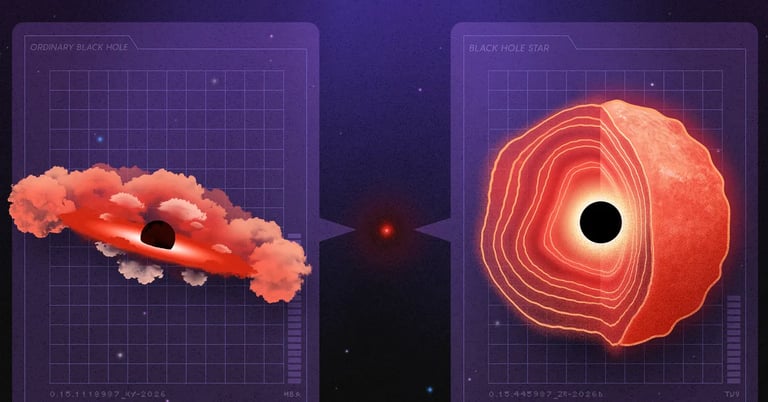

Diversified data indicate that some little red dots may be edge-on glowing by gas blocking blue light, while others could be exposed black holes, implying multiple, not mutually exclusive explanations.
Overall, no single interpretation currently prevails; researchers seek more data and clearer distinguishing patterns to determine whether these dots are traditional black holes, black hole stars, or a mixture of both.
Researchers are testing mass estimates of putative black hole seeds inside these objects and comparing predictions to spectra to clarify how massive black holes formed in the early universe.
The 'black hole star' idea builds on quasi-star concepts, proposing a black hole forms inside a massive hydrogen shell and powers a luminous outer layer, potentially explaining the Balmer break and the unusually red spectra.
The debate has become polarized, with proponents on both sides offering counterarguments—from reddening due to viewing angle to intrinsic properties and the role of surrounding gas geometry.
Quasi-star–based models were developed and refined by Begelman, Giavalisco, Naidu, and de Graaff, with some data fitting these models better than earlier black-hole–only interpretations.
Spectroscopic observations showed broad hydrogen lines in some dots, originally implying fast-moving gas around black holes, but later analyses considered electron scattering and alternative geometries that could mimic those lines.
A crucial empirical test is whether little red dots become rarer with cosmic time, consistent with a puberty-like phase in black hole growth; early 2–3 billion-year-old samples show a decline in their numbers.
Two leading interpretations have emerged: one posits the dots are traditional supermassive black holes in distant galaxies, while the other suggests black hole stars, a new class where a black hole sits inside a giant hydrogen cocoon that shines like a star and blocks X-rays.
The James Webb Space Telescope has repeatedly observed these tiny red dots in its images, fueling the major scientific debate about their nature.
Summary based on 1 source
Get a daily email with more Science stories
Source
WIRED • Oct 24, 2026
Inside the Supermassive Debate Over the James Webb Telescope’s ‘Little Red Dots’