China's Platform Strategy Propels AI, EV, and Solar Leadership
March 29, 2026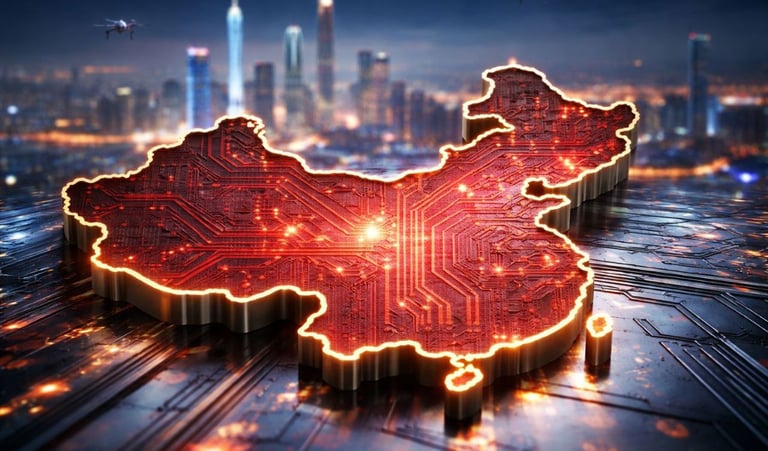

China is accelerating adoption and building national capabilities across solar, EVs, AI, and robotics through pilot programs, standards setting, data strategies, and coordinated infrastructure like a national computing power network and high-quality datasets.
Privately owned firms push dynamic competition within a state-backed framework, with regulators sometimes stepping in to curb excessive rivalry while profitability aligns with system-wide scale, integration, and rapid learning.
The piece is authored by S. Alex Young of London Business School and Angela Huiue Zhang of USC for Project Syndicate in 2026.
It notes that the U.S. remains more open and innovative, but China’s platform-style state involvement could reshape global leadership in AI and the broader industrial revolution.
The government guides direction through pilot programs, experimental zones, coordinated procurement, and regulatory support, enabling rapid industry-wide learning while firms compete within the framework.
China’s AI trajectory mirrors a platform model: open-source adoption, data-driven scaling, and government-backed data infrastructure and standards accelerate capabilities, with data treated as a strategic national asset and cross-border data rules shaping entry for foreign players like Tesla.
Data is treated as a strategic national asset, with rules on cross-border automotive data transfer tightening and affecting foreign entrants, signaling a preference for domestic data advantages and controlled interoperability.
China’s innovation system operates as a state-structured platform that guides market competition, aiming to become a global leader in AI, quantum tech, biotech, clean energy, drones, and 6G per the 15th Five-Year Plan.
This platform-driven approach emphasizes state orchestration that shapes markets and coordinates standards rather than relying solely on top-down planning or pure market competition.
China has achieved global dominance in several areas, with BYD overtaking Tesla in EV production amid domestic price competition and China controlling over 80% of the solar supply chain, while AI firms move toward open-source models to close gaps with U.S. labs.
China’s platform ecosystem reduces costs, strengthens supply chains, and accelerates diffusion of technologies, illustrating a pathway to leadership in EVs and solar through coordinated deployment and scale.
Pilot programs have sped up physical AI deployment, exemplified by Baidu’s 2022 launch of commercial unmanned robotaxi services and expansion to about twenty cities within three years, highlighting data-driven testing in real-world settings.
Summary based on 2 sources
Get a daily email with more AI stories
Sources

interest.co.nz • Mar 29, 2026
The rise of the Chinese Platform State
Logos Press • Mar 28, 2026
The emergence of the Chinese “platform state”