Germany's 'Economic Alert Day': Business Leaders Demand Urgent Reforms Amid Recession Fears
January 29, 2025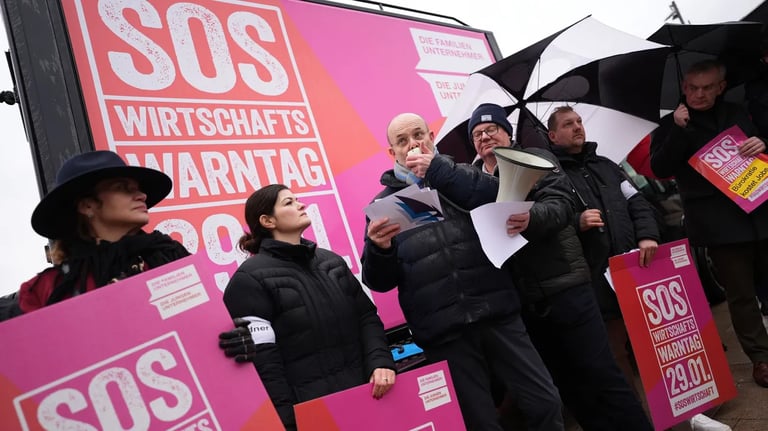

On January 29, 2025, a significant economic protest took place across Germany, organized by around one hundred business federations, with over a thousand entrepreneurs demonstrating in front of the Brandenburg Gate in Berlin.
In addition to the main event in Berlin, representatives from businesses and economic associations also gathered in downtown Hamburg to respond to a recently lowered economic forecast for the year.
This nationwide event, termed 'Wirtschaftswarntag' or economic alert day, aimed to raise awareness of the deteriorating economic situation and pressure the government to implement immediate reforms.
Protesters highlighted that the German economy has been in recession for two consecutive years, with a bleak outlook for 2025 and a significant decline in investment attractiveness.
Marie-Christine Ostermann, president of the Family Entrepreneurs Association, described the demonstrations as a 'SOS call' from entrepreneurs to politics and voters, emphasizing the dire state of the economy.
A ten-point demand paper was presented by the associations, advocating for significant changes such as reducing bureaucracy, lowering social contributions and taxes, and launching a major infrastructure initiative.
Nico Fickinger, CEO of the employers' associations Nordmetall and AGV Nord, reiterated calls for limiting social contributions to 40% and lowering corporate taxes to a competitive 25%.
Friedrich Merz from the CDU emphasized that Germany is at a critical economic juncture, calling for clear leadership and a concrete plan for the future.
Economists predict a potential third consecutive year of recession for Germany unless reforms are implemented, with the German Industry Association warning of a 'deep crisis' for the country.
The protests underscore the urgency for economic reforms amidst rising pressures, as business leaders stress the need for the government to recognize the severity of the economic crisis.
During the demonstrations, the German government revised its economic growth forecast for 2025 downward from 1.1% to just 0.3%, further fueling the calls for reform.
Marcel Fratzscher, president of the German Institute for Economic Research, criticized the 'Wirtschaftswarntag' as a corporate lobbying effort while acknowledging some valid demands from the business community.
Summary based on 6 sources