Australia and US Forge $13 Billion Pact to Revolutionize Global Mineral Supply Chain
October 22, 2025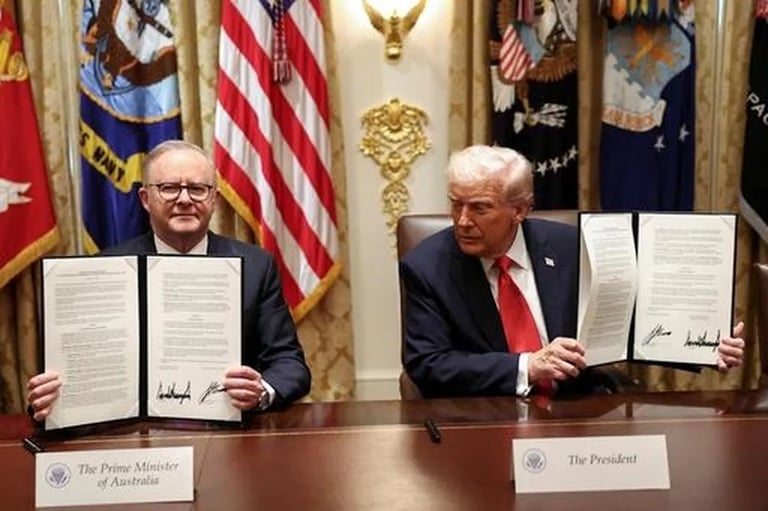


Australia has entered a strategic partnership with the US to transform global supply chains for critical minerals, aiming to reduce dependence on Chinese processing capacity and secure vital resources for technology, energy, and defense sectors.
Key projects include the Alcoa–Sojitz Gallium Recovery Project in Western Australia, expected to produce 100 million tons annually—about 10% of the global supply—and the Arafura Nolans project in the Northern Territory, containing roughly 5% of the world's rare earths.
The partnership prioritizes materials like rare earth elements, especially heavy ones such as dysprosium and terbium, which are mostly processed in China, along with battery materials like lithium, cobalt, and nickel, heavily concentrated in China and the Democratic Republic of Congo.
Implementation faces challenges including technical, regulatory, infrastructure, workforce, and market volatility risks, which could affect project timelines and costs.
A clear framework has been established with milestones such as immediate project initiation, regulatory reforms, and a comprehensive review scheduled for April 2026 to ensure progress and adapt to market and geopolitical changes.
Environmental sustainability is a core focus, with rigorous assessments, advanced waste management, and community engagement to protect ecosystems and involve local stakeholders.
The initiative is expected to generate economic benefits like job creation, increased export revenue from value-added products, and long-term industry diversification for regional communities.
Success metrics include production capacity, supply chain reliability, environmental compliance, and strategic independence, with ongoing monitoring to evaluate progress.
The US and Australia are committing around $13 billion in investments for infrastructure, technology sharing, and project development over several years, aiming to establish robust domestic processing capabilities.
Technology transfer and joint research are central to the partnership, promoting innovation in extraction, processing efficiency, and environmental management through personnel exchanges and shared facilities.
The partnership seeks to attract private investment, reduce reliance on concentrated supply sources, and foster technological innovation, with milestones for infrastructure, workforce training, and environmental standards.
While market reactions are cautiously optimistic, uncertainties remain due to geopolitical tensions, trade policies, and economic conditions, influencing commodities like oil, gold, and bitcoin.
Summary based on 24 sources
Get a daily email with more World News stories
Sources

The Guardian • Oct 22, 2025
Albanese has worked out a way to deal with Trump – even if there are areas where they don’t see eye to eye
Daily Mail • Oct 22, 2025
China delivers stern warning following Anthony Albanese's meeting with Donald Trump
The Sydney Morning Herald • Oct 23, 2025
Albanese’s meeting with Trump is a warning to Australia’s enemies
SBS Language • Oct 22, 2025
Major US-Australia critical minerals deal aims to challenge China’s dominance. Can it succeed?